

School of Music Guides: Undergraduate Music Student Handbook
Welcome to the School of Music at East Texas A&M University. We're glad you are here and we hope that you find your time on campus fulfilling and rewarding as you prepare for your music or music-related career. This handbook is your toolbox of forms, policies, procedures, opportunities, and other useful information you will need during your time as a music student. This document is not a substitute for the East Texas A&M University Undergraduate Catalog; instead, it works in conjunction with the university requirements and procedures described in that document.
Mission Statement
The School of Music of East Texas A&M University promotes excellence in music through the rigorous study of music history, literature, theory, composition, pedagogy, and the preparation of music performance in applied study and ensembles to meet the highest standards of aesthetic expression.
Vision: The School of Music
- Provides opportunities for all students to enhance their perception, comprehension, performance, and ultimately, appreciation of music.
- Prepares students to be leaders in music education, music performance, and other related fields of the performing arts.
- Fosters creative activities and the intellectual pursuit of knowledge about music.
- Enriches the lives of the students and faculty of East Texas A&M and the communities of the state and nation with inspirational performances and stimulating educational opportunities.
Values: As a School of Music, we value
- Actionable pursuit of excellence in scholarship, pedagogy and artistry;
- Curriculum, repertoire, representation and ideas that equip students to maneuver as engaged citizens in cultural leadership and global awareness;
- Curiosity and creativity as individuals and as collaborative artists;
- Professionalism and collegiality among students, faculty and staff, culminating in a culture of trust and mutual respect.
Curriculum
Applied Instruction (Private Lessons)
Eligibility for Applied Instruction
Any student may enroll in applied music study; however, if personnel resources are limited, the School of Music may not be able to accommodate every student's desire or need to study music in applied lessons. The School of Music will offer lessons to students ranked according to the following hierarchy of needs:
- music majors needing applied study for graduation;
- music minors needing applied study for graduation;
- students from other academic disciplines (non-majors or non-minors) needing applied lessons to fulfill a specific scholarship requirement;
- students from other academic disciplines who also contribute to one of the School of Music's ensembles;
- students from other academic disciplines.
Further, the School of Music may deny the opportunity to study music in applied lessons to students who, in previous semesters of applied study:
- were frequently unprepared for lessons;
- were frequently absent from lessons;
- and/or failed to pass the Junior Level Proficiency Exam after two attempts.
Course Numbers for Applied Instruction
- MUS 152/352 (2-3 SH during long semesters) for music majors only
- MUS 151/351 (1-2 SH during long semesters and summer session) for music minors and for study of secondary instrument (piano for voice majors; organ for piano majors; secondary instrument for instrumentalists)
- MUS 149 (1 SH) for all other students
Principal Applied Instruction
Undergraduate music students must master the requisite technical skills for artistic expression in at least one performance area through study in principal applied lessons. In the first two years of lower division study, the student takes Applied Music 152 for 2 or 3 semester hours depending on their degree plan (fifty minutes of lessons each week). At the end of each semester, the student performs a jury for faculty evaluation of technical progress and performance of the assigned literature. At the end of the 4th semester of study at East Texas A&M University, students will perform an extended jury known as the Junior Level Proficiency Exam (JLPE; see below for more information). After successfully completing the JLPE, the student continues applied lessons in advanced lessons (MUS 352) for fifty minutes each week. As a culmination of the MUS 352 process, all students will perform a half recital. In addition, performance majors (Bachelor of Music) will continue with MUS 352 and perform a full recital in a subsequent semester (See below for specific area length requirements).
Principal Applied Lessons (152, 352, 552) are not offered in the May-Mini, Summer, or Winter semesters.
Jury Exams
Music majors and minors must complete a jury examination at the conclusion of each semester of principal applied (MUS 152, 352) and minor applied (MUS 151) study. Students performing a half recital may have the recital graded by the appropriate faculty in lieu of the jury for the semester in which the recital is performed at the discretion of the applied instructor. Students may perform on a minor applied (MUS 151) instrument on a convocation recital or in studio class and have that performance graded by the appropriate faculty in lieu of the minor applied jury for the semester at the discretion of the applied instructor.
The material and repertoire performed for the jury exam comes from material assigned in applied study during the semester. For instrumental majors, the assigned material may include, but is not limited to scales, exercises, etudes, solos, chamber literature, and orchestral excerpts. The assigned vocal repertoire comprises memorized art songs in multiple languages, folksong arrangements, recitatives, and arias. Keyboard majors perform literature from the major style periods (e.g., Baroque, Classic, Romantic, Contemporary, etc.) In general, each member of the applied faculty establishes and states the grading policy in the course syllabus; thus, the value or weight of the jury exam on the final grade may differ between studios.
A student enrolled in restricted applied study (MUS 149) is not subject to jury examination unless required by the individual professor.
Junior Level Proficiency Exam (Jlpe)
At the end of the 4th semester of study at East Texas A&M University, all music majors must perform and pass an extended jury known as the Junior Level Proficiency Exam (JLPE). All music majors must pass the JLPE to be admitted into upper division Principal Applied lessons (MUS 352) and most other upper division courses in the School of Music. For the JLPE, the student must demonstrate technical and musical excellence, music literacy (sight reading), and the ability to perform a cross-section of standard repertoire for the specific studio area. A student who does not pass all portions of the JLPE must retake only the failed portions at the end of the following long semester. Piano majors are required to retake the entire JLPE if they fail any portion. Students are not eligible to enroll in upper division Principal Applied Lessons (MUS 352) until all portions of the JLPE are passed. A student who does not pass the second attempt at the junior level proficiency exam will no longer be allowed to continue as a music major. Transfer students are encouraged to take the JLPE at the end of their 2nd semester of applied lessons at East Texas A&M, but no later than the end of their 4th semester.
Instrumental JLPE Policies
Instrumental students must demonstrate competency in four areas of performance:
- Jury piece assigned by the instructor for that particular semester.
- Etudes/excerpts/misc. materials
- All major, minor, and chromatic scales (performed from memory)
- Played in a 4/4 time signature, with the rhythm of quarter notes and eighth notes for every measure
- Any of the 12 major, three forms of minor scales, and chromatic scale (played in steady eighth- notes) could be asked for at the JLPE. Scales will be drawn at random and performed within the same key area. For example, if the key of C is drawn, the student will perform the C Major, c natural minor, c harmonic minor and c melodic minor scale. A minimum of four key areas will be assessed.
- The minimum tempo to perform all scales is as follows:
- Woodwinds: ± = 120
- Brass: ± = 96
- Percussion: ± = 160
- Number of octaves is determined by the applied instructor.
- Sight-reading: While the jury and etudes portion is graded similar to a typical jury exam with a final number value, grading for the scales and sight-reading portion of the JLPE is based on a pass/fail system. As stated in the JLPE requirements, all students must satisfactorily perform and pass a sight- reading etude. To obtain a consistent approach and difficulty level among all studios, etudes will be selected according to a variety of factors.
Selection Requirements include:
- 16-24 measures long
- Simple or compound meter
- Key signature: up to 4 sharps or 4 flats (Major or minor key signatures; no modes)
- Occasional accidentals
- Rhythmic Values: Half-notes, Quarter-notes, Eighth-notes, Sixteenth-notes, Triplets, Syncopations
- Marked dynamics
- Marked articulations
- Marked tempo
- Simple meter: ± = 80-140
- Compound meters: ± = 60-132
The JLPE Rubric will be used for the sight-reading etude. Students will need a 2.5 average score or higher to pass the sight-reading portion of the JLPE. The rubric is published on the School of Music website; a synopsis is below.
- Students performing the etude technically correct with added musicality, not written in the music, including phrasing, nuance, and clear direction will constitute a “4” on the rubric scoring sheet.
- Students performing the etude technically correct and/or making a quick recovery will constitute a “3” on the rubric scoring sheet.
- Students performing the etude with minor technical and musical mistakes will constitute a “2” on the rubric scoring sheet.
- Students performing the etude with major technical and musical mistakes will constitute a “1” on the rubric scoring sheet.
Before performing the JLPE, students are required to submit the following at the time of their performance exam:
- The student should have their personal copy of an original score. Two copies of the solo/jury piece will be used by the jury panel.
- Two copies of the other works prepared (etudes/excerpts/misc. materials)
- Two typed copies of the semester repertoire sheet (available on the School of Music website)
Piano JLPE Policies
Keyboard students must successfully perform the literature and technical requirements assigned during their last semester of lower division applied study. Questions should be directed to Dr. Luis Sanchez, Head of the Piano Division.
Vocal JLPE Policies
For the vocal JLPE, students must successfully perform a varied and challenging repertoire that includes one piece from each of the following categories: an Italian art song, a German Lied, a French melodie, and an English art song. All four pieces will be performed to demonstrate mastery of all four languages and the ability to expressively perform various styles of music. All literature must be performed by memory. In addition to the repertoire performance requirement, students must: 1) demonstrate competency sight-singing using solfege, the text, or a neutral syllable; 2) speak a sentence written from the International Phonetic Alphabet (IPA) to the chosen language (Italian, French, or German) and transliterate words from English into IPA; and, 3) learn on their own and expressively perform an assigned selection of literature. Students will be responsible for picking up their prepared piece two weeks before their JLPE from the applied voice instructor.
Students must complete and submit five typed copies of the Jury Form and Jury Repertoire Form (under the Current Student resources section of the School of music website) to the evaluators at the time of the jury.
Applied Minor Requirements
Instrumental: Instrumental students pursuing a Bachelor of Music in instrumental performance must, in addition to their primary instrument, master the requisite technical skills for a minimum of one secondary instrument (minor applied) as part of their course of study. Students must enroll in four lower level minor applied lessons (MUS 151) as part of this sequence. These lessons would typically be taken as a one credit lessons (30 minutes per week) over four semesters. At the end of each semester the student will perform a jury for faculty evaluation of technical and musical progress over assigned literature.
Piano: performance majors must complete 7 hours of applied minor study (organ is often used), 3 of which must be upper division. They must also pass the proficiency exam for the minor applied instrument.
Vocal: Vocal majors must declare piano as their minor instrument and meet the piano proficiency requirements. (See piano proficiency requirements on p. 20)
RECITAL PERFORMANCE REQUIREMENTS
The School of Music mandates the following procedure to document a student’s performance of a recital on his or her transcript:
1. At the beginning of the semester, the applied faculty will notify the Music School Office of any students performing a recital that semesters.
2. The staff will create a section of the appropriate recital
- MUS 353 Junior (half) Recital
- MUS 453 Senior (full) Recital
The student will enroll in 1 hour of MUS 353 Junior Recital or MUS 452 Senior Recital. In addition the student will register for 1-2 hour(s) of applied lessons based on their degree plan. (i.e. Performance majors may enroll in 2 hours of applied lessons if needed to satisfy number of hours needed for graduation).
Sample Enrollments:
- Music Education Junior Level Half Recital (1 credit of MUS 353 and 1 credit of MUS 352)
- Performance Junior Level Half Recital (1 credit of MUS 353 and 2 credits of MUS 352)
- Performance Senior Level Full Recital (1 credit of MUS 453 and 2 credits of MUS 352)
3. If a student fails to complete the recital, the applied faculty member will determine if a grade of F (fail) or Incomplete (X) is appropriate. If an incomplete grade (X) is assigned, the faculty member and student must follow the procedure for receiving and removing an Incomplete (X).
Grading
The Recital Rubric will be used for the degree recital. Students will need an overall grade of C or better on the recital to be considered passing. The rubric is published on the School of Music website.
Exceeds Expectations
Meets Expectations
Below Expectations
Unsatisfactory
Performance Technique
Musicianship / Interpretation
Professionalism / Presence
Recital Hearings
All degree recitals require a “recital hearing” to be scheduled and completed prior to the recital in order for the instructor to give final approval to move forward with the recital. The hearing is graded Pass/Fail. Committee members will use the Recital Performance Scoring Rubric to determine the students' score.
The recital hearing must be completed no less than 10 business days before the recital date (policies vary by area. Consult with your applied teacher). While the hearing is recommended to occur in the performance venue, it is not required. The principal applied teacher is required to be present at the hearing and the recital. Two of the three committee members must evaluate the hearing and recital and at least two committee members should be in attendance at the hearing. The student should provide a copy of the program draft to the panel at the hearing. If the student fails the pre-recital hearing, or individual pieces at the hearing, one additional hearing may be scheduled (during the same semester) at the discretion of the committee, or the recital may be cancelled or postponed. If the recital is cancelled/postponed the student will receive a grade of F in the Principal Applied Recital course. The student will have one additional semester in which to successfully pass the recital and remain a music major. This additional attempt must be during the next consecutive long semester.
The primary instructor may cancel a student recital at any time for the following reasons:
- Lack of progress/preparation
- Failure to schedule a recital hearing, for degree recitals
- Failure to turn in the proper scheduling paperwork on time
- Failure to submit program or program notes (when applicable)
- Failure to pay accompanist fees (when applicable)
Individual faculty members can define the recital grading procedures for the course in their syllabi, as well as requirements for program notes. The scheduled dress rehearsal is merely a rehearsal and will not be graded by the committee.
Recital Scheduling
Students must adhere to the procedure for scheduling events:
- Check with your applied instructor about the procedure in your instrument area. All East Texas A&M students must obtain the permission of the instructors in their area (e.g., piano, brass, percussion, string, voice, woodwinds) to perform a recital on campus. Some areas require a recital hearing; in other areas the procedure is less formal.
- Choose 3 possible dates for your event and check against the master calendar of music events maintained online. The Music Office will not permit a simultaneous ensemble performances in the Concert Hall and a recital performance in the Recital Hall in the same division. Concert times:
- Monday-Friday: 6 p.m. and 7:30 p.m.
- Saturday and Sunday: 3 p.m., 4:30 p.m., 6 p.m. and 7:30 p.m.
- Obtain a Recital Scheduling Form from the School of Music Website or the Music Office if one or more of your performance and dress rehearsal dates are available. All wind and voice recitals will be in the Recital Hall; the percussion and piano recitals will be in the Concert Hall. A student performing a recital may have one two-hour dress rehearsal in the performance venue (2 two-hour rehearsals for percussion students) and must note that rehearsal date and time on the scheduling form. Additional rehearsal time in the venue may be arranged by the respective applied teacher through the Music Office, depending upon the availability of the facility.
- Obtain the permission/signatures required on the scheduling form.
- Check with ALL faculty/committee members who will be evaluating your recital.
- Return the form to the Music Office no later than three weeks prior to event. Any changes to the event must be made at the earliest possible moment through the School of Music Administrative Assistant.
- See the section on piano accompanists for information regarding accompanist fees.
- Provide a check payable to the East Texas A&M School of Music for $50 with the submission of the form, or use a credit card to pay through the campus Marketplace system. Students performing a half or full recital must have the performance recorded using the School of Music’s equipment and Recording Crew—an archival copy is required for accreditation and grade. The School of Music Administrative Assistant will provide a receipt to the student. Then, the student will give the receipt to the Recording Crew captain. Following the recital, the crew will provide both the student and the applied instructor one copy of the recording and will place another copy in the School of Music archives.
- If you plan a reception prior to or after the recital, provide a $50 deposit with the submission of the form. If the prep kitchen is clean with all utensils put away the following morning, the School of Music will return the deposit check. If not, the School of Music will cash the check.
- Provide Program information via the Student Recital Program Information Form available on the School of Music Website. The form should be filled out no less than 14 days before the recital. The form includes ALL information required for the program: composition titles, movement titles, composers, composer dates, additional musicians, instruments, date of recital, time of recital, degree or non-degree recital, and primary instructor(s) for recital material.
- Translations and Text (voice recitals): Programs for vocalists will include text translations as appropriate.
- Program Notes: These may or may not be required by applied instructor. All program notes will be formatted and copied by the performer, and approved by the applied faculty member. The School of Music will not print program notes.
Degree Recital Requirements
Instrumental
- Instrumental students studying for a Bachelor of Music with All-Level Certification perform a half recital in their junior or senior year. A half recital is defined as a minimum of 25 minutes of music with no more than 12 and 1/2 minutes devoted to chamber music.
- Instrumental students studying for a Bachelor of Music (performance) perform a half recital as a junior and a full recital as a senior. A full recital is defined as a minimum of 50 minutes of music with no more than 20 minutes devoted to chamber music.
- The Bachelor of Arts in Music does not require a recital.
Vocal
- Vocal students studying for a Bachelor of Music with All-Level Certification perform a half recital in their junior or senior year. A half recital is defined as a minimum of 25 minutes of music.
- Vocal students studying for a Bachelor of Music (performance) perform a half recital as a junior and a full recital as a senior. A full recital is defined as a minimum of 50 minutes of music.
- The Bachelor of Arts in Music does not require a recital.
Piano
- Piano students studying for a Bachelor of Music in piano pedagogy perform a half recital and a lecture recital. A half recital is defined as a minimum of 25 minutes of music.
- Piano students studying for a Bachelor of Music in piano performance perform a half recital as a junior and a full recital as a senior. A full recital is defined as a minimum of 50 minutes of music.
- The Bachelor of Arts in Music does not require a recital.
Ensemble Requirements
All music majors must participate in ensembles as required by their degree program and, when applicable, the terms of their scholarships. The requirement varies according to degree, principal instrument, and of course, the terms of the scholarship(s).
Instrumental Division: Every instrumental major must enroll and participate in a principal instrumental ensemble every semester in which they are a full-time music major. In addition, every instrumental music education major is required to be in the Pride Marching Band for four semesters. Transfer students are required to participate in The “Pride” Marching Band for a minimum of two semesters, unless waived by the Director of Instrumental Activities.
Keyboard Division: Piano majors must complete a minimum of six semester hours of ensemble to meet the 6 semester hour requirement of the Music Core. Piano majors studying for the Bachelor of Music with All-Level Certification fulfill this requirement by 1) performing in the ensemble determined by their minor instrument (e.g., applied minor instrument: perform in band; applied minor voice: sing in choir), 2) performing in a chamber ensemble, and/or 3) performing as an accompanist. Piano performance majors fulfill the requirement by performing with a chamber ensemble or as an accompanist for choir or solo voice or instrument.
Vocal Division: Every vocal major must enroll and participate in a principal vocal ensemble (e.g., University Singers, Chorale) every semester in which they are a full-time music major.
Piano Proficiency
All music majors must demonstrate proficiency in piano; however, the proficiency requirement differs for instrumental and vocal students. (NB: Keyboard majors must pass the applied proficiency exam.)
Instrumental majors must pass Class Piano, level C (MUS 236) with a grade of C or higher. By default all incoming students are automatically enrolled in Class Piano A (MUS 136). Any incoming student with prior piano experience may attempt to test into Class Piano B (MUS 140) or into Class Piano C (MUS 236) by contacting the Class Piano course instructor prior to or during the first week of classes. It is possible that the MUS 236 requirement itself may be waived if a student displays sufficient skill. (NB: It is extremely rare for a student to demonstrate sufficient skill to merit the recommendation that any, or all, of the piano class levels be waived.)
Vocal majors working towards the BM with All-Level Certification degree must declare piano as their applied minor. Accordingly, they must enroll in Class Piano (MUS 136 or MUS 140, depending on their prior experience at the keyboard). All vocal majors must pass Class Piano Level C (MUS 236) with a grade of C or higher, before they may enroll in upper-division Applied Piano (MUS 351). Then, they must enroll in upper-division Applied Piano (MUS 351) until they pass the upper-division proficiency exam.
Vocal majors in the Bachelor of Music program must complete 4 hours of lower division applied piano (MUS 236) and MUS 151, pass the proficiency exam, complete 4 additional semester hours of study at the upper division level (MUS 351), and pass the upper division proficiency exam.
Regardless of the level, a vocal music student may not enroll for more than 1 semester hour of piano (half-hour lesson) in a given semester.
Convocation/recital Attendance Requirements
All undergraduate music majors must enroll in and pass six semesters of MUS 100R (Convocation) to graduate from East Texas A&M University with a baccalaureate degree in music. Convocations are scheduled on Wednesdays at 4:00 p.m. and consist of recitals and lectures. Transfer students must enroll in MUS 100R each semester until graduation, student teaching, or until four semesters have been passed (whichever comes first). The pass/fail grades for recital attendance are based on the number of recitals/concerts attended during each semester. Other requirements are described on the MUS 100R syllabus.
If you are asked to participate in a Convocation recital by your applied instructor, you must submit your information by Friday at 5 p.m. the week before your performance. The form is available on the Student Resources page on the School of Music Website.
Recital Etiquette
- Turn off cell phones, watches, or any other noise-making device before entering any performance venue.
- Avoid doing anything that might be a distraction to the performers or other audience members.
- Applause should be reserved until the end of each section during the recital/concert
- Dress to attend daytime/afternoon recitals in everyday school attire.
- Dress for evening recitals in professional attire. (At minimum, wear dress slacks with dress shirts or blouses, dress shoes, etc.)
- Gentlemen should remove caps or hats in performance venues.
- Display respect for yourself, others, and the art of music!
School of Music Educator Preparation Program
The School of Music works in direct cooperation with the Office of Educator Certification and Academic Services and the Texas Education Agency to communicate about related policies and procedures during music education coursework and clinical teaching.
EC-12 Certification
In the state of Texas, prospective music teachers apply for and earn All-Level (EC-12) certification. The requirements include:
- Full admission into the Field Based Teacher Education Program (This typically occurs the sophomore year during MUS 222: Introduction to Music Education.)
- Completion of Basic Skills Requirements:
- The Reading component must be met with a score of 250 or higher on Reading THEA or appropriate SAT or ACT score
- The Math component may be met with a “C” in college algebra (or appropriate test score)
- The Writing component may be met with a “C” or higher in English 1301 or 1302 (or appropriate test score)
- Documented 50 hours of Field Based Experience: 25 in-person and/or electronic observation hours and 25 active teaching hours. 25 of the hours must be at the elementary level (PK-5 general music) and 25 at the secondary level (band, choir, orchestra, Mariachi, theory). The host/mentor teach must be certified to teach music in the state of Texas. These hours are spread over several courses:
- MUS 222 Introduction to Music Education, 5 hours
- MUS 325 The Music Teaching Profession, 10 hours
- MUS 423/424 Advanced Conducting, 5 hours
- MUS 400 Classroom Management, Assessment, and Special Populations, 10 hours
- MUS 450 Music and Movement I, 10 hours
- MUS 465 Music and Movement II, 10 hours
- Completion of all university coursework
- Overall GPA requirement of 2.75
- Complete required Interdisciplinary Core, Specialization, and Professional Development courses with a GPA of 2.75 and no grade less than a C
- Submission of the ETAMU School of Music Application for Clinical Teaching Google form
- Submission of Application for Field-Based Clinical Teaching through TK-20 during your MUS 325 (formerly SED 300) class. The application normally opens the first class day and closes the twelfth class day. If you have already taken MUS 325 (SED 300), you will not receive a notification that the application has been opened.
- Completion of and all district requirements, such as applications, interviews, orientation, or fingerprinting. Missing a deadline may result in the postponement of your clinical teaching for another semester.
Timeline
- Two semesters before clinical teaching, in November or April, the student completes the ETAMU School of Music Application for Clinical Teaching Google form.
- At the beginning of the semester preceding clinical teaching, the student submits the Application for Field-Based Clinical Teaching through TK-20 during the MUS 325 (formerly SED 300) class. The application normally opens the first class day and closes the twelfth class day. If the student has already taken MUS 325 (SED 300), they will not receive a notification that the application has been opened.
- The student and SOM faculty advisory team (including the Coordinator of Music Education, Director of Bands, and Director of Choral Activities) will confer regarding possible schools for placement. Though students are allowed to make requests, the final decision rests with the faculty advisory team. Students are placed within 30 traveling minutes of where they will be living during the clinical teaching semester. The SOM avoids placements in a school the student previously attended or with a student's former PK-12 teacher.
- The Coordinator of Music Education makes arrangements with the requested school districts (Human Resources personnel, Fine Arts Directors, principals, and teachers) to make the placement assignments.
Request for Extended Secondary Placement
As a default, every SOM clinical teacher is placed in a secondary school for 8 weeks and an elementary school for 8 weeks. (Clinical teachers usually move between both a middle school, and ahigh school during their secondary placement.) In exceptional cases, a 16-week extended placement at a secondary site may be arranged (8 weeks at a middle school and 8 weeks at a high school), contingent on student fulfillment of School of Music requirements. Any student requesting extended 16-week placement at the secondary level must:
- Complete a minimum of 25 Field Based Experience hours in an elementary placement, or combination of placements, in person (no video hours)
- Complete MUS 450 Music and Movement I and MUS 465 Music and Movement II with a B or better.
- Request an extended 16-week secondary placement on the Application for Clinical Teaching and justify the request. This will be reviewed by the SOM faculty advisory committee which will make the decision to approve or deny the request.
Placement Outside Partnership Districts
If for some reason a student requests a clinical teaching placement outside of the East Texas A&M partnership districts, the student will be responsible for securing a qualifies University Field Supervisor for each placement. The students will contract with the Field Supervisor/s directly and pay them directly. Placement approval is not guaranteed and will be considered on a case-by-case basis.
The Clinical teacher must attend all East Texas A&M SOM Seminar meetings (face-to-face, in person, at the Dallas campus), Clinical Teacher Orientation, Teacher Job Fairs and Training Days, following the East Texas A&M Som Clinical teaching calendar for these events.
During the clinical teaching semester, the prospective music teacher must apply for certification through the East Texas A&M Office of Educator Certification and Academic Services and pass the TExES exam.
The School of Music encourages music education students to maximize their time in the field-based program. To that end, the School of Music expects clinical teachers to begin attending their assignments when the Cooperating Teacher begins work in the late summer (e.g., band camp) and continue until activities conclude in December (even after university graduation). Similarly, students in the spring should begin in early January when the Cooperating Teacher begins work and continue until activities conclude in May. Thus, they have multiple opportunities to study with strong teachers in a variety of successful music programs.
Taking the TExES Exam
The TExES Exam has two parts:
- the Music Content Exam (MCT)
- the Pedagogy and Professional Responsibilities Exam (PPR)
Students must take and pass both the Music Content Exam and the PPR to apply for certification to teach in the state of Texas. We work very hard to prepare students for these requirements and are proud of the university's very high success rate.
Beginning with the graduating class of May 2027, all music education students must PASS both the Music Content Test and the PPR to be approved for clinical teaching. Over the next few semesters, we are gradually working toward this end. Tentative schedule:
| If your Graduation Date is… | Your task for the Penultimate Semester | Your task for the Clinical Teaching Semester |
| May 2026 | Fall 2025 – You must PASS the Music practice test (CertifyTeacher) with 80% accuracy in every domain to be approved for clinical teaching. | Spring 2026 – You must PASS the Music Content Test (TExES) to graduate. You must PASS the practice PPR (CertifyTeacher) with 80% accuracy in every domain to graduate. |
| Dec 2026 | Spring 2026 – You must PASS the Music Content Test (TExES) to be approved for clinical teaching. You must PASS the practice PPR (CertifyTeacher) with 80% accuracy in every domain to be approved for clinical teaching. | Fall 2026 – You must PASS the PPR Test (TExES) to graduate. |
| May 2027 | Fall 2026 – You must PASS the Music Content Test (TExES) to be approved for clinical teaching. You must PASS the PPR Test (TExES) to be approved for clinical teaching. |
Music Content Test
Take the Music Content Test (MCT) first. You will need School of Music approval to take the MCT. To earn this approval, you must pass the practice test from CertifyTeacher with a score of 80% or better in EVERY DOMAIN.
- To get approval to take the MCT, complete this Laserfiche form. You will be asked to submit your scores from the practice test.
- Once you submit it, it will first be sent to Dr. Meek. Her approval will be sent to the Office of Educator Certification and Academic Services. Ms. Bryan in Educator Certification will then contact you with instructions. Please contact Ms. Bryan directly if you have difficulties registering for the exam.
Pedagogy and Professional Responsibilities
- After you pass the MCT, follow the same process to receive authorization to take the Pedagogy and Professional Responsibilities (PPR) for the PPR.
- You will receive an email from the Educator Certification office with instructions on how to register for your PPR exam.
How do I prepare for the tests?
The East Texas A&M University Testing Center offers practice exams for the TExES certification exams:
- The East Texas A&M Assessment Office offers numerous TExES Representative Forms (official practice tests) for $20
- All versions of the PPR are available.
- The tests are five hours long.
- You must have your instructor's approval before you are allowed to register. Your instructor will then contact the Assessment Office.
Other Resources Available through the Waters Library
CertifyTeacher—Preparation Software for Educator Certification Information
- Interactive Practice Tests, Representative Tests, Practice Sessions, & Flashcards for Review are all included in the Purchase Price. With the East Texas A&M University membership, the purchase price will be approximately $50. Please follow the directions below very carefully, to take advantage of this great opportunity.
- Practice tests for both the PPR and the Music Content Test are available in CertifyTeacher.
- Promo Code for East Texas A&M University students. The Promo Code is TEXES4728
Follow these steps to purchase CertifyTeacher:
- Go to CertifyTeacher
- Select the study guide you wish to purchase – make sure to select the online version option. Remember – access is granted until you receive a passing grade from the state
- Click Login under the Apply Promo Code option on the My Shopping Cart page
- Click Sign In under “I Don't Have an Account Yet” to create your account
- Make sure to use your university e-mail address when creating the account.
- The promo code will not work for any other e-mail.
- Enter the Promo Code TEXES4728 when prompted.
- The price will drop to the discount price after that.
- Select Accept in the Six Clock-Hours Requirement window for your promo code to be validated.
- Complete the purchase transaction by providing your credit card information. You will be able to access your online readiness review solution seconds after the purchase transaction is complete
- You are entitled access to your (CertifyTeacher) Test Prep Solution for up to 3 years from the date of purchase or until you pass your state assessment, whichever comes first. Your program will prompt you to renew your access every 35 days. Renewing your product is free of charge.
Other Preparation Materials
- Mometrix eLibrary
- (On the homepage of the database, type “Pedagogy and Professional Responsibilities” and hit search. You can also type “Music Content” for music materials.)
- Learning Express Library
- (on the homepage of the database, type “Pedagogy and Professional Responsibilities” and hit search)
- TMEA Study Guide
- Pearson
- East Texas A&M’s Google folder of helpful study information.
- East Texas A&M University Mentor Center Online Representative Exam, 903.468.3144
- TExES study guides can be found in the Velma Waters Library
- Study.com
- Texas Educator Certification Examination Program
How do I register to take the test?
- Visit the Texas Educator Certification Examination Program website. Information about specific testing times can be found on this website.
- Choose the location to determine what dates are available for that particular testing site. TExES exams have different times/dates according to the location site chosen.
What if I do not pass the MCT or PPR?
- If you do not pass one of the two exams on the first try, you will have to wait 30 days before retaking the exam. You will need to be authorized to register for any additional retakes. Requirements for reauthorization will be determined on an individual student basis. It is important to remember that you have up to 5 attempts to pass each exam.
- If you are unsuccessful on the Music Content Test or PPR, access the Study Plan Tracker. This embedded program within Certify Teacher will help you address the areas of concern based on your completed Exam Mode 0. This “remediation” plan will generate assignments based on the domains/competencies below 80%. Study Plan Tracker must show 100% complete on ALL areas prior to submitting.
- Use the TExES Test Approval Form to get approval to retake the test. You will be asked to submit your Study Plan Tracker scores.
List of Fees for Music Education Students
This is a list of all fees for which Music Education students are responsible. These fees are subject to change.
| YEAR | COURSE | ITEM | FEE |
| Sophomore | MUS 222: Introduction to Music Education | Purchase TK-20 | $139 |
| Educator Preparation Program Application | $50 | ||
| Senior (penultimate) | MUS 325: The Music Teaching Profession | Application for Student Teaching | $50 |
| TEA Assessment Fee | $35 | ||
| TExES test fees | $140 per test | ||
| Senior (clinical teaching) | MUS 406: Clinical Teaching Seminar for Music Educators | Application for a Teaching Certificate | $78 |
| Vendor Fees | $10 | ||
| Fingerprinting Fee | $40.25 | ||
| Graduation Fee | $40 (This fee does not include cap and gown) | ||
| TOTAL: $687.25 |
Accompanist Policies
Instructions and Policies for Instrumental Students
Section 1: Student and Professional Accompanist Fees for Instrumental Students
Accompanist fees will be the responsibility of the student for juries, studio recitals, studio classes, and degree recitals. The School of Music will be responsible for covering the cost of accompanist fees for departmental student recitals, including convocations and the honors recital.
| INSTRUMENTALPERFORMANCE | STUDENT ACCOMPANIST | PROFESSIONAL ACCOMPANIST |
| Full Recital(over 30 minutes of music) | $150-200 +4 hours of rehearsals/lessons, recital hearing, dress rehearsal, and performance | $200-250 +4 hours of rehearsals / lessons; hearing, dress rehearsal and performance |
| Half Recital(30 minutes of music and under) | $1,252 hours of rehearsal/lessons, recital hearing, dress rehearsal, and performance | $200-250 +4 hours of rehearsals/lessons; hearing, dress rehearsal and performance |
| Departmental Student Recital*pd by department | $402 services and recital performance | $502 services and recital performance |
| Jury | $402 services and jury performance | $502 services and jury performance |
| Extra Lessons, Rehearsals | $15 per service *paid in advance* | $20 per service *paid in advance* |
| Extra Performances | $15 each *paid in advance* Extra rehearsals not included | $20 each *paid in advance* Extra rehearsals not included |
Note: A service is defined as a 30 minute rehearsal/lesson
+ Accompanist will provide the exact fee depending on the amount of music to be performed.
Section 2: Professional Accompanists for Instrumental Students
If a student prefers to have a professional accompanist, the student is responsible for contacting the accompanist of choice directly as early as possible in the semester. The student will submit the Accompanist Request Form, music, and payment to the professional accompanist directly.
Section 3: Student Accompanists for Instrumental Students
If a student prefers to have a student accompanist, the student is responsible for requesting one from Ms. Vanatta 6 weeks prior to the performance date. A request is not complete until the Accompanist Request Form and music have been submitted to Ms. Vanatta in Room 230 or her mailbox. The student and both students' principal applied instructors will receive an e-mail indicating the name and contact information of the assigned accompanist. If there are no students available or if the difficulty of the music is not appropriate for a student accompanist, the student and both students' principal applied instructors will receive an e-mail advising the student to contact a professional accompanist. For jury semesters, payment is due at the first rehearsal. For recital semesters, half payment is due at first rehearsal and full payment is due at dress rehearsal. Accompanists will not provide services past these landmarks without payment.
Student Responsibilities
- Accompanists and soloists will handle their collaboration in a professional manner. Concerns that cannot be addressed to the satisfaction of all involved should be brought to the attention of Ms. Vanatta immediately.
- Accompanists and soloists will maintain professional communications regarding the scheduling of services. Soloists will communicate the dates of all rehearsals, lessons, performances, and changes to the schedule in a timely manner. Services missed due to lack of advance notice will not be rescheduled.
- Accompanists will demonstrate consistent and reasonable preparation for all rehearsals and performances of the repertoire they are committed to perform. Soloists will provide legible copies of the music with metronome markings (originals preferred) and recordings, if possible, to the accompanist.
- If additional services or performances are desired, the soloist must consult with the accompanist regarding scheduling and must pay the fee in advance of the service or performance.
- If a performance must be canceled, the accompanist is entitled to receive payment for one-half the estimated total fees or for services rendered, whichever is greater.
- If a departmental student recital performance is canceled by the soloist, the soloist and not the Department is responsible for the accompanist fee.
- Accompanists will refuse service if the agreed payment schedule is not fulfilled.
Instructions and Policies for Vocal Students
Student and Professional Accompanist Fees for Vocal Students
Accompanist fees will be the responsibility of the student for juries and degree recitals. The School of Music will be responsible for covering the cost of accompanist fees for weekly studio classes and for departmental student recitals, including convocations and honors recital.
| VOCAL PERFORMANCE | STUDENT ACCOMPANIST | PROFESSIONAL ACCOMPANIST |
| Semester registered for 1 hour | $755 services, mock jury, and jury | $1,005 services, mock jury, and jury |
| Semester registered for 2 hours | $15,010 services, mock jury, and jury | $20,010 services, mock jury, and jury |
| Departmental Student Recital *pd by department* | $402 extra services and performance | $502 extra services and performance |
| Half-Recital Semester | $18,012 services, recital hearing, dress rehearsal, and performance | $24,012 services, recital hearing, dress rehearsal, and performance |
| Full-Recital Semester | $22,515 services, recital hearing, dress rehearsal, and performance | $30,015 services, recital hearing, dress rehearsal, and performance |
| Extra Lessons/Rehearsals | $15 per service *must be paid in advance* | $20 per service *must be paid in advance* |
| Extra Performances | $15 each *paid in advance* Extra rehearsals not included | $20 each *paid in advance* Extra rehearsals not included |
Note: A service is defined as a 30 minute rehearsal/lesson
Payment Schedule
In all cases of a non-recital semester, full payment is due by WEEK 4. Accompanists will not provide services until full payment is received. In all cases of a recital semester, payment is expected according to the following schedule: full payment is due by WEEK 4 or by the date of the recital hearing, whichever is first. Accompanists will not provide services past these weeks without full payment.
Procedure for Assignment of Accompanists
During first week of classes
Returning Students: contact your previously assigned accompanist, coordinate your schedules, and communicate possible lesson times to your applied teacher. Complete the accompanist request form and return it to your teacher. It is beneficial to everyone when vocalists and pianists can nurture a successful working relationship over many semesters. If it is not possible to schedule a time with your previously assigned accompanist, notate that on the form and a new accompanist will be assigned to you. If you have a preference of accompanists, indicate that preference on the form and requests will be honored as schedules permit.
New Students, or Students Who Need New Accompanist: complete the accompanist request form and return it to your teacher. If you have a preference of accompanists, indicate that preference on the form and requests will be honored as schedules permit.
- By the end of second week: Applied teachers will give the forms with lesson times and preferences noted to Ms. Maxwell. Assignments will be made according to requests and availability.
- By the end of third week: Ms. Maxwell will return the forms to the applied teachers with assignments noted. She will also distribute the forms to the assigned accompanists. Students and accompanists should contact one another as soon as possible to finalize the details of the assignment.
- During the fourth week: Students will give the full accompanying fee and legible copies of the music to the assigned accompanist. No services will be given until both fee and music have been received.
Student Responsibilities
- Accompanists and soloists will handle their collaboration in a professional manner. This includes communications regarding the scheduling of services. Soloists will communicate the dates of all rehearsals, lessons, performances, and changes to the schedule in a timely manner. Services missed due to lack of advance notice will not be rescheduled. Concerns that cannot be addressed to the satisfaction of all involved should be brought to the attention of Ms. Maxwell immediately.
- Accompanists will demonstrate consistent and reasonable preparation for all rehearsals and performances of the repertoire they are committed to perform. Soloists will provide legible copies of the music and recordings, if possible, to the accompanist during WEEK 4 of the semester. No new music should be given to the accompanist past WEEK 10. If new music is needed past this week, Ms. Maxwell should be notified immediately in order to make other arrangements for the performance of the piece.
- If a performance must be canceled, the accompanist is entitled to receive payment for one-half the estimated total fees or for services rendered, whichever is greater.
- Accompanists will refuse service if the agreed payment scheduled is not fulfilled.
Facilities and Equipment
Music Building Hours
The Music Building is open the following hours:
- Monday–Friday 6 a.m. to 12 a.m. (limited access 11:00-12:00)
- Saturday 8 a.m. to 11 p.m. (limited access all day)
- Sunday 12 p.m. to 12 a.m. (limited access all day)
During Limited Access times, students will only be able to access the building using the swipe lock system on the back doors. The School of Music Office will compile a list of qualified students. This list will be regularly updated and given to UPD and the Facilities Office. Only authorized personnel are to be in the building during Limited Access hours. Students who allow non-authorized personnel to enter or who are in the building after hours are subject to disciplinary action, including the revocation of access privileges.
On evenings when the stadium is used by high schools for football games or track meets, the custodians will lock the building at 5:00 p.m. If you are in the building at that time, you may remain and practice until midnight; however, if you leave after 5:00 p.m., you must use the swipe card system to gain entry.
Any request for deviations from these times needs to be cleared through the School of Music Head in advance of the event or activity.
Building Security
The faculty, staff and students assume responsibility for building security. Faculty members may confiscate University-owned instruments left unattended by a student and levy a fine against the offending student; thus, it is the student's responsibility to make sure all instruments and personal belongings are secure when not in use. Students are expected to report activities or behaviors that are potentially destructive or abusive to a faculty or staff member, or the University Police. As a community of scholars and artists, it is imperative that everyone take responsibility for their own actions and be aware of the actions of others in the Music Building, and to work for the safety and security of all faculty, staff, students, patrons, and guests in the Music Building.
Keys
Keys are assigned to students for specific rooms and venues as they pertain to either student work or official student organization activities. Once a need for the key arises, a student should see the School of Music's administrative associate to order and/or sign out the appropriate key, pending School of Music approval. There will be a fee for lost keys (fees vary based on amount of rooms that may need to be re-keyed as a result). Students may also be blocked from registering for subsequent semesters or from graduation if keys are not returned and/or fees are not paid.
Lobby and Lounge Areas
The Music Building lobby and lounge areas are designed for informal gatherings, study sessions, or as a reception area for performances. Since these spaces are used by students, faculty, and members of the audience, keep these areas clean at all times. Do not practice or participate in other activities in these spaces that may interfere with rehearsals or performances. Food is permitted in the first-floor east entrance lobby (the PIE Lounge); however, food and drinks, other than capped water containers, are not permitted on the second floor or in any rehearsal hall, performance hall, or carpeted space in the Music Building.
Lockers
The School of Music provides instrument storage lockers to music majors and non-majors currently enrolled in East Texas A&M sponsored ensembles, following the established guidelines and policies described herein. These policies will be regularly enforced to ensure consistent treatment of students, and to ensure the safety and security of university and student-owned equipment.
- Lockers are issued to music majors and minors at the discretion of the School of Music, primarily for storage of instruments, music, and other equipment pertaining to the School of Music. You are responsible to report any damage to the music office and may be expected to pay for the repair or replacement if the locker is damaged due to negligence or misuse.
- Lockers are usually issued prior to, or at the start of the fall semester, and are available during the fall and spring semesters. Lockers may be available during the summer semesters on a case-by-case basis, based on availability, justification, and at the discretion of the School of Music Head.
- Unissued (empty) lockers may not be claimed or used by students without following official School of Music procedures as described below. Instruments or other equipment found in unissued lockers will be removed by School of Music personnel.
- Students may not share lockers. Each student must check-out his/her own locker. Items in unauthorized/shared lockers will be removed and both students will lose locker access.
- Only locks issued by the School of Music are to be used on university lockers. Personal locks will be cut-off by School of Music personnel at the student's expense, and the contents will be removed. Lockers should be kept locked at all times, with personal belongings stored inside, rather than above, around, or near your locker. The university is not responsible for lost or stolen property, especially if you fail to lock your locker.
- All lockers are subject to search at any time by University personnel. Prohibited items that are found in lockers will be surrendered to Campus Police and the student will be reported to the Dean of Students. Prohibited items include but are not limited to drugs, tobacco products, vape products, alcohol, items that may cause harm to the building or its occupants, flammable or combustible items, or items that are not allowed in other campus facilities. Any student with a license to carry a concealed weapon may not store the weapon in a university locker at any time for any reason.
- Lockers should be kept free of trash or other debris that could attract rodents and pests. Lockers that contain excessive amounts of trash may be emptied at the School of Music's discretion, and the students' locker will be revoked upon the third offense.
- Since lockers in the main hallways are visible to the public, decorations of any kind (including stickers or decals) are not permitted on locker doors.
- Neither the School of Music, nor its representatives (faculty, staff, graduate assistants, or student workers) will, at any time for any reason, allow students to gain access to a locker that has been issued to another student.
To Obtain a (wire-front) Instrument Storage Locker
The graduate assistant for bands assigns lockers in the instrument storage rooms for university-owned instruments. To request an instrument-storage locker, see the band-area / instrumental graduate assistant (GA).
To Obtain a Hallway Locker
- Visit the School of Music's Market Place page to complete the locker request form and pay the $10.00 locker fee.
- Once you complete the form and pay the fee, you will receive a copy of a purchase receipt. Shortly afterwards, you will receive a second email from the music office with your locker assignment and lock combination. If the lock combination does not work, or if you have other issues regarding your locker assignment, come to the music office to talk with Ms. Christina Gower at [email protected] or 903-886-5303.
To Return a Locker
- Empty your locker of all contents (this includes trash and miscellaneous papers) and clean as needed. Keep the lock on the locker and ensure it is locked.
- On Thursday of Final Exam week, a student worker and/or staff member will inspect the locker. If there are no issues, you are clear. However, if trash or personal belongings are found in your locker, your name will be submitted to the music office, and a hold will be placed on your record.
- If a hold is placed on your record, remove the items from your locker and contact the music office to have your locker inspected again. The hold will not be removed until your locker is emptied and cleared.
- Items that are not removed by May 31st will be removed by School of Music personnel and placed in lost and found.
Bulletin Boards
School of Music information is posted on the bulletin board in the east entrance lobby (PIE Lounge). Students may post information on this board only with the permission of the Music Administrative Assistant. Individual studio news is posted on bulletin boards located by each studio door. Ensemble information is posted outside the respective ensemble reception areas. Student organization bulletin boards are for the use of those organizations only.
Practice Rooms
Practice rooms are a vital part of any music institution. Practice Rooms are available only to students majoring in music or non-music majors enrolled in ensembles or lessons. To maintain clean practice rooms with usable pianos, please be individually and collectively accountable.
Care and Maintenance of the Practice Rooms
- Leave practice rooms in a clean, orderly state.
- Food and drinks are not permitted in the practice rooms! You may bring water in a capped container and set the container on the floor, but never on the piano!
- Throw away your trash and any other found refuse into the trash cans located in the hallway.
- Do not attempt to reserve practice rooms by leaving instruments, music, or cases in a room.
- Do not move stands from the rehearsal halls; rather, provide your own wire stand for the practice rooms.
- Do not practice in the hallways, sound locks, or any undesignated space at any time.
- Instrument cases and book bags must be kept in your locker or in the practice room with you. Do not leave cases or other belongings in the hallway during your practice session.
Finally, to ensure that every music major has the opportunity to practice the School of Music has established the following guidelines:
Daytime Practice Hours
Monday through Friday: 6 a.m. to 5 p.m.
Saturday: 8 a.m. to 5 p.m.
Sunday: 12 to 5 p.m. (Evening Rules in effect after 5 p.m.)
Daytime Rules
- The occupant is limited to 30-minute sessions.
- The occupant must vacate at the half-hour.
- The occupant may reclaim the room for an additional 30-minute session is no one is waiting.
- Wind players are limited to the 12 rooms in the East Wing. Pianists and vocalists are strongly encouraged to use the practice rooms in the Central Wing when available
Evening Rules (Sunday through Thursday: 5 to 10 p.m.)
- Woodwind majors may use Rms. 168, 170, 172, 174.
- Brass majors may use Rms. 161, 162, 163, 164, 165, 176.
- Voice majors may use Rms. 169, 171 in the East Wing and 137, 138, 140, 142, and 144 in the Central Wing.
- Piano majors may use Rms. 136, 137, 138, 140, 141, 142, 144, and 145 in the Central Wing.
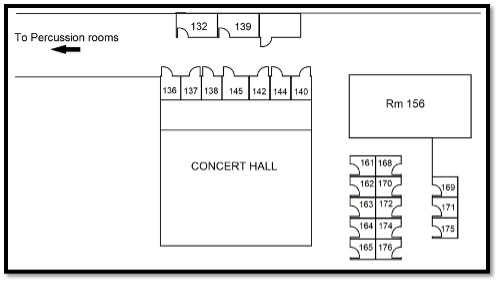
Percussion majors may sign up through the Percussion GA for weekly time in percussion practice rooms and the percussion ensemble room. Percussion students may also sign up for practice times in the band hall and Ellison Hall when those rooms are not in use for sectional rehearsals. (NB: The Dual-Purpose Classroom (Rm. 158) is not available for percussion practice in the evenings.)
- The occupant must vacate at the half-hour.
- The occupant may reclaim the room for an additional 30-minute session if no one is waiting.
- If unoccupied 5 minutes after the half-hour, the room is considered open to all instruments or voice; however, winds are still restricted to the 12 rooms of the East Wing.
Dual Purpose Classroom (158), Band Room, and Ellison Hall (156)(5 to 10:30 p.m.)
- These rooms are open for chamber ensembles and sectionals. (NB: Percussionists may sign up for a time in the band room or Ellison Hall when those rooms are not in use for chamber ensembles or sectionals.)
- The Dual Purpose Classroom (Rm. 158) and Ellison Hall are regularly scheduled by ensemble directors or, in the case of chamber ensembles, scheduled by sponsoring applied faculty through Shelbie Blackstone.
After-Hours (Sunday through Thursday: 10:30 p.m. to 12 a.m.)
- The building will be locked at 11 p.m.
- The UPD will make spot checks of the building after closing time. Any students found in the building after posted hours will be instructed to leave immediately and will be subject to disciplinary action, including the revocation of access privileges. (NB: the custodial staff has been instructed to tell the students they need to leave and if there is an issue, they will call UPD.)
- All students staying after-hours must exit through a panic-bar door and double-check that it locks behind them.
Music Library
The School of Music's music holdings (e.g., books, recordings, scores) are housed in the Velma K. Waters Library. Currently, Sarah Northam is the designated faculty liaison for the School of Music. Students may also reach out to Ms. Northam for research and library assistance. Music materials are located on the fifth floor of the library and can be located through the library's OneSearch tool. Library materials may be checked out at the Circulation Desk using their CWID. Music scores not owned by the library can be requested using Interlibrary Loan. Students may listen to audio materials on the 1st floor of the library by checking out study room 158B – 158E. Students may only listen to recordings in the library; they may not check out audio materials. Additionally, the Library has acquired subscriptions to a wide variety of online reference, audio, and video resources. Students may access these resources using their MyLeo login credentials. Students must be currently enrolled to check out materials and access online resources.
MUSIC SCHOLARSHIPS
The School of Music awards the Music Scholarship and Housing Scholarship and determines the amount according to the talent and musicianship displayed by the student in the audition, the ensemble need for the instrument or voice type, and the student's proposed major. Scholarships are extended to the student each successive year for a total of four years subject to the student's:
- satisfactory completion, participation and progress in the assigned ensemble(s) and applied lesson(s) each semester,
- satisfactory progress as a full-time student (register for 15 SH, complete 12 SH),
- minimum GPA of 2.75 to retain the Music Scholarship,
- minimum GPA of 2.5 for the first 60 hours attempted and 3.0 thereafter to retain the Housing Scholarship.
At the end of each semester, the Scholarship Committee, comprising the division heads and the School of Music Head, reviews the academic progress of all students receiving a Music Scholarship. (NB: The Scholarship Office assesses the eligibility of students receiving the Housing Scholarship.) At that time, the Committee terminates the scholarship of any student who does not meet the stated GPA and enrollment requirements or places that student on scholarship probation or suspension. Regardless, the Committee notifies the student of the action in writing.
Music Scholarships and Housing Scholarships appear as a credit on the student's bill. In general, students' accounts are credited with the scholarship and waiver, usually in the first three weeks of the semester.
The University and the School of Music require all students on scholarship to be enrolled in a minimum of 15 credit hours. Exceptions to this rule are considered on a case-by-case basis. To request an exemption, complete the 15-hour scholarship exemption request form available on the School of Music website (in the resources for current students). Your request will be reviewed by your division head and by the School of Music head.
ENDOWED MUSIC SCHOLARSHIPS
The School of Music also awards endowed scholarships to music majors according to the terms and criteria established by each endowment. In general, these awards go to continuing music majors who have demonstrated exceptional musicianship, academic achievement, involvement and service to the School of Music. Near the start of the Spring semester, you will receive an email from the School of Music that will contain more information and the application link. The scholarship applications are typically due in March with awardees notified by the end of the Spring Semester.
Music Student Organizations
Students at East Texas A&M have the opportunity to join an honorary music student organizations. These organizations provide academic recognition for the members, service to the School of Music, and the opportunity for social interaction among those interested in music. Students may learn more about and join these organizations each spring.
The music organizations comprise:
Academic Advising
All music students are assigned an advisor in the College of Humanities, Social Sciences and the Arts. The main advisor for music majors is Amanda Scott. New students will have a registration hold on their account for the first two semesters or until 24 credit hours have been completed at East Texas A&M and are required to meet with their academic advisor to register for courses. At the School of Music level, advisors are typically the students’ applied instructor. Advisors meet regularly with each student to monitor progress and advise students on course selection in their respective course of study. The School of Music advisor, division coordinator and School of Music, maintain information on each student’s pertinent records (e.g., audition and admission applications, scholarship offers and letters of acceptance, jury evaluations, recital programs, proficiency exam reports, etc.). The student and advisors may electronically access the student’s updated academic records (transcripts and degree audits) using myLEO (DegreeWorks).
When you first register, you must declare a music major and a degree (e.g., Bachelor of Music (Music Education), Bachelor of Music (Performance), or Bachelor of Arts in Music); then you will see the course of study and progress listed and reviewed on your DegreeWorks. If you see errors, contact your academic advisor. Students must review their degree audit (DegreeWorks) in myLEO and refer to the relevant sections of the Undergraduate Catalog (e.g., “Core Curriculum,” “Music,” and “Secondary and Higher Education.”) prior to pre- registration.
It is essential that you consult your academic and School of Music advisor prior to every registration so that you stay on track, avoid omitting required courses, take the courses in proper sequence, and avoid inadvertently taking courses that are not required in your field of study. You must also consult with your advisors prior to dropping or adding a course. Although advisors strive to provide the best possible assistance to each student, the ultimate responsibility for scheduling courses and in proper sequence remains with the student.
Helpful Hints
- Keep your advisor informed of your progress and any changes in your schedule during the semester.
- Be aware of the ‘30 hour rule‘ and the ‘3-peat rule‘ about tuition rates.
- Be aware of the ‘6-course drop rule‘ described on the registrar’s website.
- You may not drop a developmental course (ENG 101 MATH 120 131 ) or a basic skills course (ENG 1301, MATH 1332, 1342, 1314, 1325).
- Many upper-division music courses are offered on alternating years or semesters.
- Know the proficiency, jury, and recital requirements for your principal applied and minor applied instruments.
- Know the piano proficiency requirements for your degree program.
- If you receive a music scholarship, you must register for at least 15 semester hours (SH) each semester and complete at least 12 SH per semester with a cumulative GPA of 2.75.
- If you receive a housing scholarship, you must maintain a minimum 2.5 GPA for the first 60 hours attempted and a minimum 3.0 GPA after 60 hours.
- If you are a music education major, you must maintain a minimum cumulative GPA of 2.75 and a minimum GPA of 2.75 in the field of specialization with no course grade less than a C.
- Music students may apply the following music courses to the University Studies and professional courses:
- MUS 1315 (World Music)
- One from MUS 323 (Music History Early – 1750) or MUS 324 (Music History 1750 – Present)
- All music majors must earn a minimum grade of a C in all Music Core classes in order to advance to upper-division Principal Applied lessons (MUS 352). These classes include the four-semester sequence of basic theory (MUS 1311, 1312, 2311, 2312) and the four-semester sequence of ear training (MUS 1116, 1117, 2116, 2117).
- Finally, students who wish to transfer credits from another institution must adhere to University rules:
- The last 60 hours prior to graduation must be taken at a senior-level institution.
- The last 36 hours prior to graduation must be advanced-level courses (300 and above). Also, the student may only transfer in 6 advanced semester hours from a senior-level institution.
- All music students who graduate from East Texas A&M must pass their proficiency exams and perform their recitals at East Texas A&M.