


Office of Institutional Effectiveness
Improving Our University
You’re here to advance your future. We’re here to make sure that happens.
Our Mission
The Office of Institutional Effectiveness serves to advance East Texas A&M's mission, vision and effectiveness by facilitating integrated strategic planning, assessment, and reporting to support data-informed decision-making, policy formation, academic program development, accreditation efforts, and continuous improvement at the university.

Assessment
East Texas A&M identifies expected outcomes, assesses the extent to which it achieves these outcomes, and provides evidence of seeking improvement based on analysis of the results for each of its educational programs and support units. These assessment practices are overseen through a university-wide institutional effectiveness process governed by university procedure 03.01.99.R0.03 Institutional Effectiveness and directed by the Department of Institutional Effectiveness and Research in conjunction with the Institutional Effectiveness Leadership Team, which includes representatives from every college and division of East Texas A&M.
Assessment Resources
Nuventive™ Improvement Platform
To begin, log in to the Nuventive Improvement Platform. The platform can also be accessed through the applications tab in myLEO. If you have questions regarding the Nuventive Improvement Platform or assessment, please view the information and resources below or contact Institutional Effectiveness.
Deadlines
- September 1: 2025-26 IE Reports and 2026-27 IE Plan updates due
Nuventive Resources
Events

ACCREDITATIONS
East Texas A&M University is accredited by the Southern Association of Colleges and Schools Commission on Colleges (SACSCOC) to award baccalaureate, masters, educational specialist, and doctorate degrees. East Texas A&M University also may offer credentials such as certificates and diplomas at approved degree levels. Questions about the accreditation of East Texas A&M University may be directed in writing to the Southern Association of Colleges and Schools Commission on Colleges at 1866 Southern Lane, Decatur, GA 30033-4097, by calling 404.679.4500, or by using information available on SACSCOC's website (www.sacscoc.org).
Every 10 years, institutions of higher education, including East Texas A&M University, reaffirm their accreditation in the Southern Association of Colleges and Schools Commission on Colleges (SACSCOC). SACSCOC is the body for the accreditation of degree-granting higher education institutions in the southern states.
To inquire about East Texas A&M’s accreditation process, please contact Dr. Ricky Dobbs or 903.468.8707.
Every 10 years, institutions of higher education, including East Texas A&M, reaffirm their accreditation in the Southern Association of Colleges and Schools Commission on Colleges (SACSCOC). SACSCOC is the body for the accreditation of degree-granting higher education institutions in the southern states.
SACSCOC requires accurate representation of accreditation status to recognized agencies, and East Texas A&M has numerous schools, colleges, programs and departments accredited by various entities, providing evidence of the university’s high educational standards. Many programs are proudly accredited by members of various examining bodies, including boards, agencies, and commissions, that attest to the credibility of East Texas A&M’s educational offerings.
American Bar Association (ABA)
- The American Bar Association (ABA) approves the Bachelor of Arts or Bachelor of Science in Paralegal Studies program at East Texas A&M as meeting the ABA guidelines. For more information, please contact Cameron Lenahan.
American Chemical Society (ACS)
- The American Chemical Society (ACS) approves the Chemistry program at East Texas A&M as meeting the ACS guidelines. ACS authorizes the chair of the ACS-approved program to certify graduating students who complete a Bachelor of Science in Chemistry as meeting the ACS guidelines. For more information, please contact Dr. Ben Jang.
American Veterinary Medical Association, Committee on Veterinary Technical Education and Activities (AVMA, CVTEA)
- The East Texas A&M University Bachelor of Science in Veterinary Biomedical Technology program is accredited by the American Veterinary Medical Association (AVMA), and accreditation standards are reviewed by the Committee on Veterinary Technician Education and Activities (CVTEA) For more formation, please contact Catrina Soto.
Association to Advance Collegiate Schools of Business (AACSB)
- The College of Business at East Texas A&M is an accredited member of AACSB International – The Association to Advance Collegiate Schools of Business. For more information, please contact Guclu Atinc.
Commission on Collegiate Nursing Education (CCNE)
- The baccalaureate and master's degrees in Nursing at East Texas A&M are accredited by the Commission on Collegiate Nursing Education. For more information, please contact Denise Neill.
Computing Accreditation Commission of ABET
- The Bachelor of Science in Computer Science is accredited by the Computing Accreditation Commission (CAC) of ABET. For more information, please contact Dr. Abdullah Arslan.
Council for Accreditation of Counseling and Related Educational Programs (CACREP)
- The Master of Science in Counseling, emphasis in Clinical Mental Health Counseling, and the Doctor of Philosophy in Counselor Education and Supervision are accredited by the Council for Accreditation of Counseling and Related Educational Programs (CACREP). For more information, please contact Dr. Michael Schmit.
Council on Social Work Education (CSWE)
- The Bachelors and Masters Programs in Social Work at East Texas A&M are accredited by the Council on Social Work Education (CSWE). For more information, please contact Marcella Smith.
Engineering Accreditation Commission of ABET
- The Bachelor of Science in Construction Engineering is accredited by the Engineering Accreditation Commission of ABET (October 2012). The Bachelor of Science in Industrial Engineering is accredited by the Engineering Accreditation Commission of ABET (October 2004). The Bachelor of Science in Electrical Engineering is accredited by the Engineering Accreditation Commission of ABET (October 2021). For more information, please contact Dr. Burchan Aydin.
National Association of Schools of Art and Design (NASAD)
- East Texas A&M is an accredited associate institutional member of the National Association of Schools of Art and Design (NASAD). For more information, please contact Dr. Laurel Carpenter.
National Association of Schools of Music (NASM)
- East Texas A&M University is accredited by the National Association of Schools of Music (NASM). For more information, please contact Dr. David Scott.
State Board for Educator Certification (SBEC)
- The State Board for Educator Certification (SBEC) accredits all programs leading to educational certification in the College of Education and Human Services. For more information, please contact Sherri Harwell.
Accreditation Council for Education in Nutrition and Dietetics (ACEND) of the Academy of Nutrition and Dietetics
- The Didactic Program in Dietetics (DPD) at East Texas A&M University has been granted candidacy accreditation by the Accreditation Council for Education in Nutrition and Dietetics of the Academy of Nutrition and Dietetics.
- The Dietetic Internship program at East Texas A&M University has been granted candidacy accreditation by the Accreditation Council for Education in Nutrition and Dietetics of the Academy of Nutrition and Dietetics. For more information, please contact Rebecca Bridgefarmer.
East Texas A&M identifies, evaluates and publishes goals and outcomes for student achievement.
Faculty Credentialing
The Office of Institutional Effectiveness (IE) is an integral part of faculty credentialing at East Texas A&M University. IE works to ensure that all East Texas A&M instructors of record are qualified to teach in their instructional discipline. IE's work, combined with various departments and colleges across campus, support compliance with SACSCOC Principle of Accreditation and faculty expectations. We persist with this work each semester. Continuous compliance is a priority of IE.
- Faculty Roster Form Link
- The Faculty Credential Inventory is used by East Texas A&M to document and justify faculty qualifications in accordance with SACSCOC Standard 6.2.a and guidance from Faculty Credentials Guidelines.
PROGRAM APPROVALS
The Process
East Texas A&M provides notification to or seeks approval from the A&M System, the Texas Higher Education Coordinating Board and/or SACSCOC for program changes, including:
- Degree program or certificate program additions, closures or changes.
- Distance education: online, off-campus face-to-face, electronic-to-groups and competency-based education.
- Changes to existing programs including program title, degree designator, CIP code, or semester credit hours
- Administrative requests for changes to or the creation of colleges, schools, divisions and departments.
- Creation of centers or institutes and others.
Some changes may require prior approval by SACSCOC or separate notification to the Commission.
The Office of Institutional Effectiveness provides guidance regarding A&M System, THECB and SACSCOC policies involving proposal or prospectus requirements and the approval process.
All program proposals listed below require internal approvals that are facilitated through CourseLeaf, which opens each fall term.
Please contact Mary Rosene with questions about required internal or external approvals.
New Degree Program
- A Preliminary Request Form must be submitted to propose a new degree program
- All new degree programs must be submitted and internally approved through CourseLeaf
- New degree programs require Texas A&M University System and Texas Higher Education Coordinating Board (THECB) approvals and may also require SACSCOC notification or approval.
- A Planning Notification must be submitted for academic bachelor’s, master’s, doctoral, and professional degrees prior to submission of the full degree program proposal. Planning notification for all doctoral and professional programs must be submitted one year prior to submission of the full proposal.
Complete the following form to initiate a new degree program request:
New Certificate Program
- A Preliminary Request Form must be submitted to propose a new certificate program
- All new certificate programs must be submitted and internally approved through CourseLeaf
- The request will require notification to the Texas A&M University System and Texas Higher Education Coordinating Board and may also require SACSCOC notification or approval
Complete the following form to initiate a new certificate program request:
All program changes listed below require internal approvals that are facilitated through CourseLeaf, which opens each fall term.
Please contact Mary Rosene with questions about required internal or external approvals.
- Change in program CIP code
- Change in program title
- Change in degree designator
- Change in program total semester credit hours
- Adding a program delivery method (hybrid online, 100% online, face-to-face/in-person, competency-based)
- Discontinuing a program delivery method (hybrid online, 100% online, face-to-face/in-person, competency-based)
- Adding a program to a new off-campus location
- Discontinuing a program at an existing off-campus location
- Closing a degree program or certificate
Changes to an existing degree or certificate program
- A Request Form for Changes to Existing Programs must be submitted to propose a change to an existing program
- All changes to existing programs must be submitted and internally approved through CourseLeaf, which opens each fall term
- Changes to existing programs require Texas A&M University System and Texas Higher Education Coordinating Board notification or approval and may also require SACSCOC notification or approval
Complete the following form to initiate a request for a change to an existing program. Attach a copy of the completed form when submitting the changes through CourseLeaf. You will be contacted with information about what external approvals are required for the change.
What definitions and restrictions apply to the available distance education modalities?
- A Hybrid Online program is a degree program in which students complete more than 50 percent but less than 100 percent of the credit hours required for the program through Distance Education courses
- A 100% Online program is a degree program in which students complete 100 percent of the credit hours required for the program through 100-Percent Online Courses. Requirements for on-campus or in-person orientation, testing, academic support services, internships/fieldwork, or other non-instructional activities do not exclude a program from this category. International, F1 and M1 visa students are unable to enroll in these programs unless the program is also approved for a face-to-face delivery method.
- A Hybrid Course is a distance education course in which more than 50 percent but less than 100 percent of instructional activity takes place when the student(s) and instructor(s) are in separate physical locations.
- A 100-Percent Online Course is a distance education course in which 100 percent of instructional activity takes place when the student(s) and instructor(s) are in separate physical locations. Requirements for on-campus or in-person orientation, testing, academic support services, internships/fieldwork, or other non-instructional activities do not exclude a course from this category.
Administrative changes involve the creation of or changes to an academic administrative unit. Administrative changes include:
- Creating a new administrative unit – colleges, schools, divisions, departments.
- Renaming an existing administrative unit
- Relocating an existing department or program to a different administrative unit
- Consolidating existing administrative units
Note: All administrative change requests require submission through A&M System office and notification of THECB.
Complete the following form to initiate this request:
- When considering the creation of a center or institute, please refer to East Texas A&M procedure 11.02.99.R0.01 Centers and Institutes.
- System Requirements for a New Center or Institute
STRATEGIC PLANNING FOR INSTITUTIONAL EFFECTIVENESS
The Office of Institutional Effectiveness serves as the support and resource center for strategic planning and continuous data-driven improvement. This office’s mission is to assist and coordinate assessment, facilitate accreditation, assist in the development of new academic programs and communicate information that supports strategic continuous improvement.
University's Mission
We transform lives by providing an accessible education in an environment where faculty and staff care and are dedicated to the success of all our students throughout their academic career. We empower our students, faculty and staff to become the best version of themselves by supporting their continuous development and growth. Fueled by our resilience, tenacity, and talents, we strengthen the rural and urban communities we serve. Innovation is the heartbeat of East Texas A&M University, with career preparedness as a cornerstone of our educational mission. We are committed to ensuring our graduates are well-prepared for the challenges and opportunities that lie ahead. Through robust career exploration, internships, industry partnerships, and skill development initiatives, we bridge the gap between academia and the workplace.
University's Vision
As a premier institution of higher education in East Texas, we are a student-ready university. We lead in social mobility, achieving academic excellence in a wide range of traditional and interdisciplinary programs and serve as a national leader in the advancement of competency-based education. We further knowledge through impactful research and creative activity that benefits the region we serve and beyond. Recognized nationally for our innovative spirit and unique rural-urban identity, we promote an environment where all are valued, providing access and opportunities to ensure student success, career preparedness, and professional development for all members of the university community.
The Office of the President provides information regarding the East Texas A&M University Strategic Plan.
News Spotlights

What is the Field of Human Services? Dr. Rusty Fox Explains
Learn how ETAMU's Human Services degree can build practical helping skills and prepare students for careers and graduate study in counseling.

ETAMU Director Named to State Financial Education Board
The director of ETAMU’s Money Management Center has been selected for a statewide leadership role focused on advancing financial literacy in higher education.
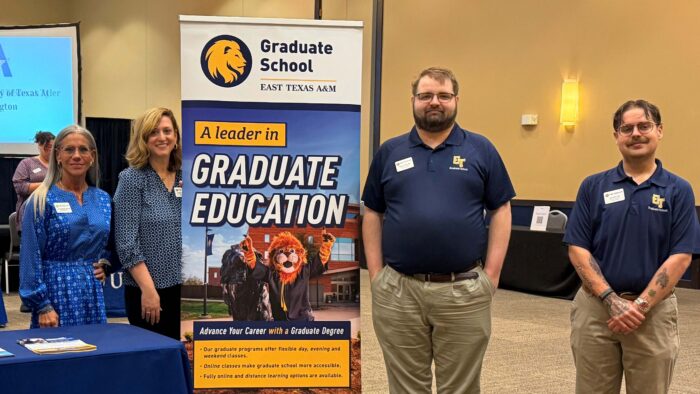
East Texas A&M Fair Connects Undergraduates With Graduate and Professional Schools
The TACRAO graduate and professional school fair helped undergraduate students explore programs, admissions and funding opportunities.
News Spotlights

East Texas A&M Named Among TIME’s Top 500 Colleges
East Texas A&M University made the inaugural list of TIME's America's Best Colleges of 2026-2027, earning a place among 500 institutions included in the publication's first national ranking.
ETAMU Ranks Among the Top Nursing, Engineering, and Social Mobility Programs in U.S. News & World Report 2025
The 2025 U.S. News rankings showcase ETAMU's dedication to quality programs, affordability, and life-changing opportunities for students.

A&M-Commerce Emerges as the Fastest-Growing Public University in Texas
Texas A&M University-Commerce is the fastest-growing public university in Texas according to recent data from the Texas Higher Education Coordinating Board (THECB). The university experienced a 12.5% enrollment surge this fall, boasting the highest percentage increase among all public universities in Texas. A&M-Commerce also secured third place for headcount increases among all public universities in […]
Meet our Department

Contact Us
- Office of Institutional Effectiveness
- 903.886.5942 or 903.886.5439
- [email protected]
- McDowell Administration Building, 3rd Floor, Suite 348
- P.O. Box 3011, Commerce, TX 75429-3011