


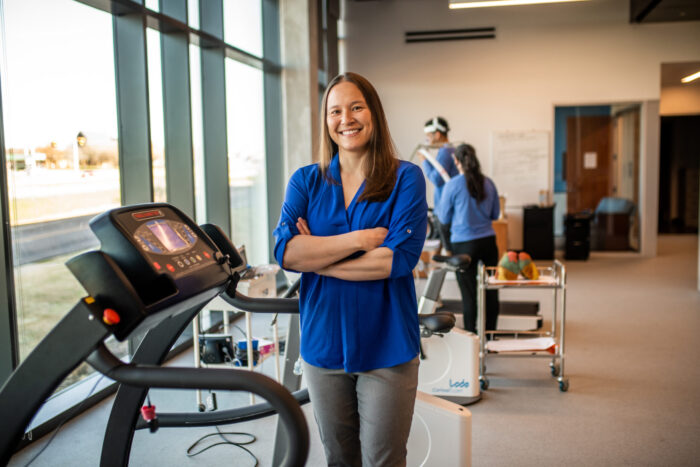
I can answer questions related to the coursework and potential career paths after graduation (there are many!)
Vipa Bernhardt, Ph.D., OLY Associate Professor
- Faculty
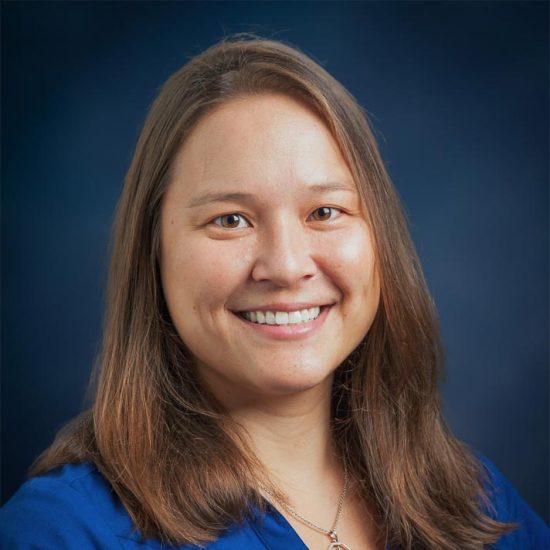
Swimming from an early age, Vipa Bernhardt grew up with a passion for human performance. She grew up in Germany and perfected her swimming style which led to participating in such competitions as the German Olympic Trials and World Championships. During her senior year, Dr. Bernhardt was offered a scholarship from the University of Florida. She took this opportunity and combined her education with sport to further her education. Her fascination with physiology and exercise performance grew throughout her graduate work to the point that she integrated her neuroscience and physiology background with her love of athletics. Now, she shares her experiences with future health and human performance professionals through her professorship and teaching.
A Conversation with Dr. Bernhardt
Besides teaching in the classroom, how are you involved in helping students succeed?
I currently serve as the Department Head of Health and Human Performance, where my focus is on creating the conditions that enable students to thrive. In this role, I help ensure that our programs provide meaningful coursework and learning opportunities that prepare students for careers in kinesiology, public health, sport management, and nutrition. I support faculty in expanding their research, professional development, and industry engagement, which, in turn, creates more applied learning and research opportunities that enrich the student experience and better prepare graduates for success beyond the classroom.
What has been your favorite course to teach?
Exercise Physiology, which is the study of how the body responds while we exercise and how it adapts with exercise training. We cover the main systems of the human body: respiratory, cardiovascular, muscular, and nervous system and study how they interconnect.
Tell us about an academic project you are working on or recently completed.
I currently serve as the measurement lead for the Texas Wellbeing Collaborative, a multi-institutional initiative aimed at improving student wellbeing and success across the state. At East Texas A&M University, I oversee the design, implementation, and analysis of a large-scale student wellbeing survey. The data are incorporated into an interactive dashboard that will help university leaders identify areas of strength and concern, develop targeted interventions, and track progress over time. This project exemplifies the university's commitment to evidence-based decision-making and student-centered innovation.
Educational Background
- Postdoctoral Research Fellow, Institute for Exercise and Environmental Medicine, Texas Health Presbyterian Hospital Dallas and UT Southwestern Medical Center, 2011-2014
- Ph.D., Biomedical Sciences, University of Florida, 2010
- B.S., Neurobiological Sciences, University of Florida, 2006
- B.A., Music, University of Florida, 2006
SELECTED Honors and Awards
- Phi Pi Delta “Lion Heart” Award, ETAMU, 2025
- Faculty Development Grant, TAMUC, 2023
- Junior Faculty Research Award, TAMUC, 2017
Professional Organizations
- American College of Sports Medicine, member
- Texas Chapter of the American College of Sports Medicine, Continuing Education Director
Featured Courses
- HHPK 355: Evidence Based Practice in Kinesiology
- HHPK 450: Exercise Physiology
- HHPK 532: Cardiopulmonary Physiology
- HHPK 545: Advanced Exercise Physiology
- HHPK 664: Fitness Testing and Exercise Prescription
Selected Publications
- Balmain BN, Bernhardt V. Beyond the Borg Scale: probability-based insights into exertional dyspnea ratings. Chest. 2025.
- Ramirez O, Bernhardt V. “Using Fitbit competitions to increase physical activity in college students.” The Macksey Journal. 2020.
- Bernhardt V, Bhammar DM, Marines-Price R, Babb TG. “Weight loss reduces dyspnea on exertion and unpleasantness of dyspnea in obese men.” Respiratory Physiology and Neurobiology. 261:55-61. 2019.
- Bernhardt V, Babb TG. “Exertional dyspnoea in obesity.” European Respiratory Review. 142:487-495. 2016.
Related News
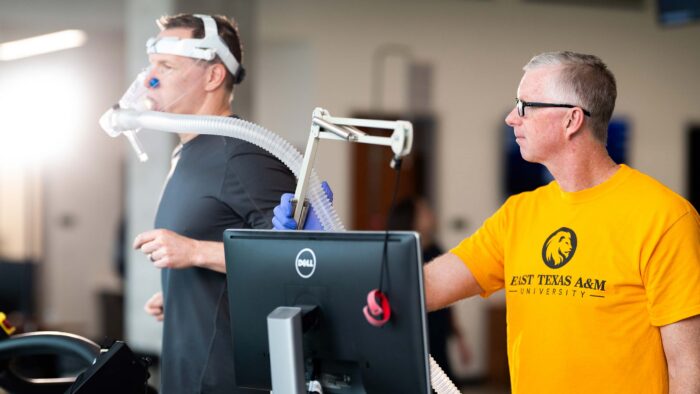
ETAMU Researchers Advance Athlete and Tactical Readiness at ROARHP Lab
The Department of Health and Human Performance at East Texas A&M is home to one of the most versatile and innovative facilities in the region: the ROARHP Lab.