


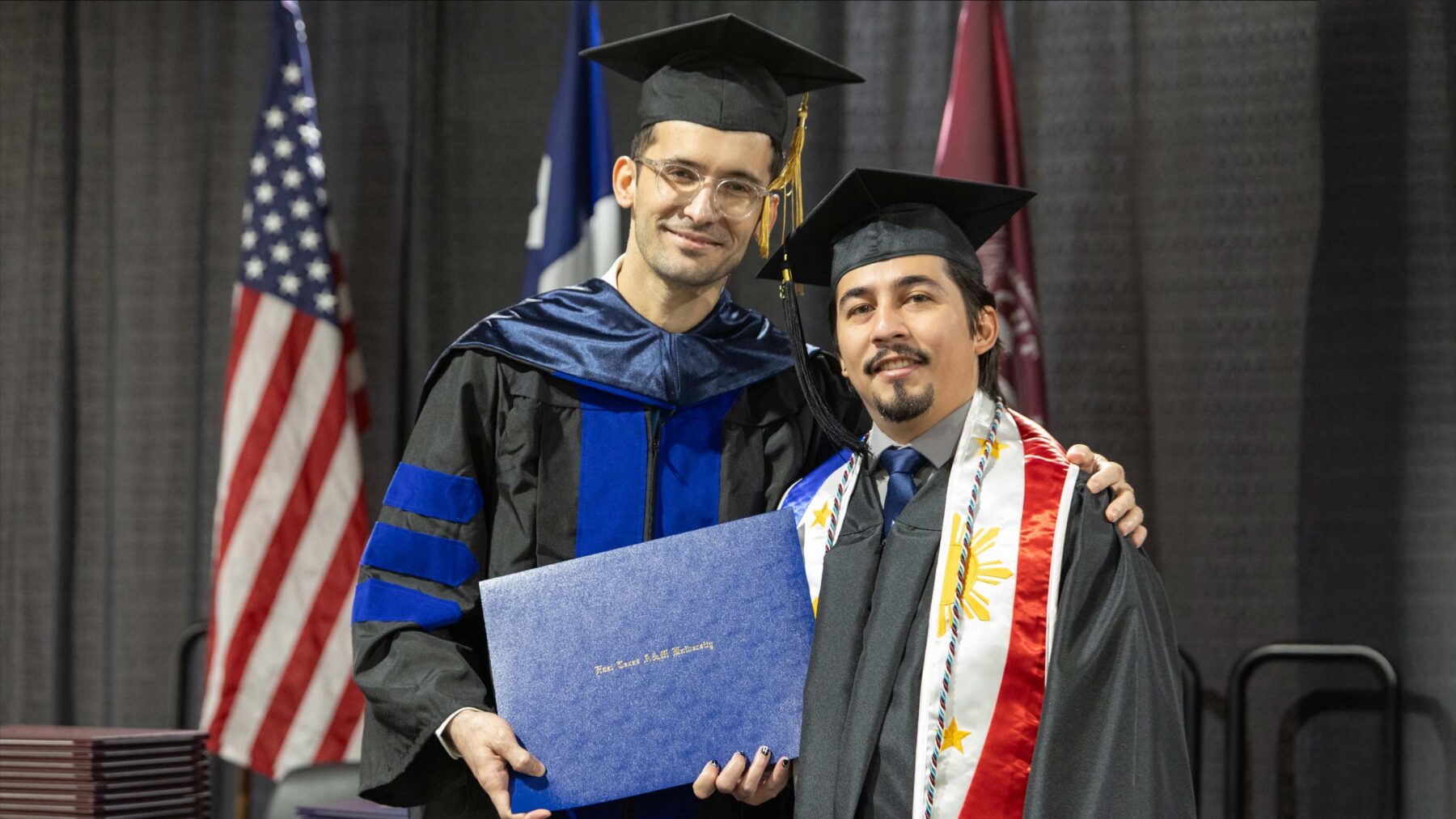
RELLIS Graduate Presents Cybersecurity Research at ARES 2026
Thomas Bakaysa grew up in the Philippines and came to the U.S. at 14. After starting his college journey at the University of Texas at Austin, life led him to East Texas A&M-RELLIS. While earning his computer science degree, Bakaysa helped build a research tool and presented the accompanying paper at ARES 2026, the International Conference on Availability, Reliability and Security, in Linköping, Sweden. ARES is a CORE Tier B conference with an 18.8% acceptance rate this year. Only about 4% of the full papers presented came from the United States.
The project builds on Dr. Ahmet Kurt's research into botnet threats on the Bitcoin Lightning Network. Bakaysa's work resulted in a tool that creates a monitored network of Lightning nodes that simulates a botnet, letting researchers customize how the network is built, tested, and taken down.
“Ethically, this system lives on one machine and does not touch the internet,” Bakaysa said. The data the tool generates can help researchers detect and combat real botnets.
A botnet on the Lightning Network is a concern because attackers could use it to secretly send commands to infected computers, and the network's privacy features can help hide who is in control. That makes such a botnet harder for defenders to detect and shut down.
The project began in Kurt's Fall 2024 capstone class. Bakaysa got involved at the end of the Spring 2025 semester, when Kurt asked for volunteers in his Network Security class.
“From there I worked on it through the summer under close supervision by Professor Kurt, forming the foundation for the tool,” Bakaysa said. He kept working on it through December. The work drew directly on his RELLIS coursework. “Python, Docker and distributed systems all aligned with what I had been studying at RELLIS, from Networking with Professor Hays, Secure Software Development with Professor Alsmirat and Network Security with Professor Kurt.”
At the conference, Bakaysa presented to an audience of PhD and master's students.
“I presented the tool itself, what [it] was, why it was made, the threat vector it hoped to mitigate and the preliminary findings that were gleaned from the tool,” he said.
Bakaysa credits Kurt for “providing the resources and the expertise required to really make sure the project took off. He made sure everything was in line and on time.” When school and two jobs limited Bakaysa's time during his final semester, Kurt took over and carried the project to the finish line.
Bakaysa also credits Dr. Amy Hays for her guidance and support. “Having someone so firmly in your corner does wonders for motivation and belief in oneself,” he said.
His advice for other RELLIS students considering research or international opportunities is simple:
“You don't have to know everything about it, you don't have to be the expert, you just have to be willing to start and to learn along the way,” Bakaysa said. “I didn't know anything about Docker or the Bitcoin Lightning Network, but I was willing to put in the work. Be bold. You never know where saying yes can take you.”
ETAMU offers three bachelor's degrees at RELLIS: computer science, computer information systems, and cybersecurity. RELLIS gives students the opportunity to earn degrees in high-demand fields close to home.