



East Texas A&M Robotics Team Builds Success Through Skill and Teamwork
Top-ranked robotics team showcases how hands-on competition builds STEM skills, teamwork and real-world experience.
The East Texas A&M University robotics team, known as Lion Pride Robotics, is quickly establishing itself as one of the top programs in the state, and beyond.
Currently ranked number one in Texas, the team has compiled an impressive record over the past two seasons, earning a place among the top competitors nationally and globally. Most recently, the team secured a tournament championship at the VEX Robotics competition in Houston. Now, they are headed for the World Championship in St. Louis, Missouri, on April 21 through 30, to take on the highest level of collegiate competition in the VEX U division.
From Classroom to Competition
The four-member team is led by co-captains Zach Pittman and Bradyn Hamm andincludes Dharsan Raviselvam and Vaden Wood. The team is under the direction of Dr. Perry Moler, associate professor in the Department of Engineering and Technology and director of the university's Makerspace.
Moler credits the team's success to a strong pipeline of students with prior experience from high school robotics and a collaborative environment that allows them to thrive.
“We have a great bunch of students coming in, and like athletics, we're developing from high-quality high school teams and carrying that success forward,” Moler said.
That pipeline has translated into a program where students take ownership of their work. Rather than directing every step, Moler takes a mentorship approach.
“My role is more of, ‘What resources do you need?' and then I get out of the way,” he said.
That balance allows students to apply classroom knowledge in a competitive, high-pressure environment.
What Is VEX U?
ET's robotics team competes in VEX U, the collegiate level of VEX Robotics. VEX U is widely regarded as one of the premier collegiate robotics competitions in the world, bringing together top university teams to compete at the highest level of design, programming and engineering.
Each season introduces a new game with unique rules and objectives. Teams must analyze the game, develop a strategy and build a robot capable of completing tasks within strict time limits—often just 90 seconds—with driver-controlled action. In addition to match play, teams are evaluated on engineering notebooks, design processes and interviews.
The process requires far more than technical knowledge. It demands planning, adaptability and continuous improvement.
Learning Through Building—and Failing
For Pittman, a computer science student and co-captain, robotics offers a unique learning environment grounded in collaboration and problem-solving.
“Being able to work together with my teammates and build something as a group rather than on my own is what sells it for me,” Pittman said.
That collaborative environment extends into every phase of the design process, where mistakes become growth opportunities.
“Learning is facilitated through making mistakes. The ones we don't get quite right are what we overcome and adapt from,” Pittman said.
Through iteration and testing, students develop both technical expertise and resilience, skills essential to engineering and technology fields.
The Power of Teamwork
While robotics is often associated with coding and mechanical design, students say teamwork is just as important as technical ability.
“We each take responsibility for different parts of the project,” said Wood, an industrial engineering sophomore. “We take advantage of our diverse skills, experience and knowledge to perform multiple tasks at once.”
That collaboration creates an environment where ideas are constantly refined and improved.
Bradyn Hamm, who contributes heavily to design and documentation, said working as a team allows Lion Pride Robotics to approach challenges from multiple perspectives.
“By having multiple people working on one project, everybody sees a different side of it,” Hamm said.
The result is a system where communication, trust and shared responsibility drive success.
Building Real-World Skills
Participation in robotics competitions provides students with a wide range of practical, career-ready skills that extend beyond the lab.
Students gain experience in programming, computer-aided design (CAD), mechanical systems and technical documentation. They also develop soft skills such as communication, conflict resolution and presentation, skills that are highly valued by employers.
“We can train hard skills, but the soft skills like conflict resolution, communication, presentation, is what really sets students apart,” Moler said.
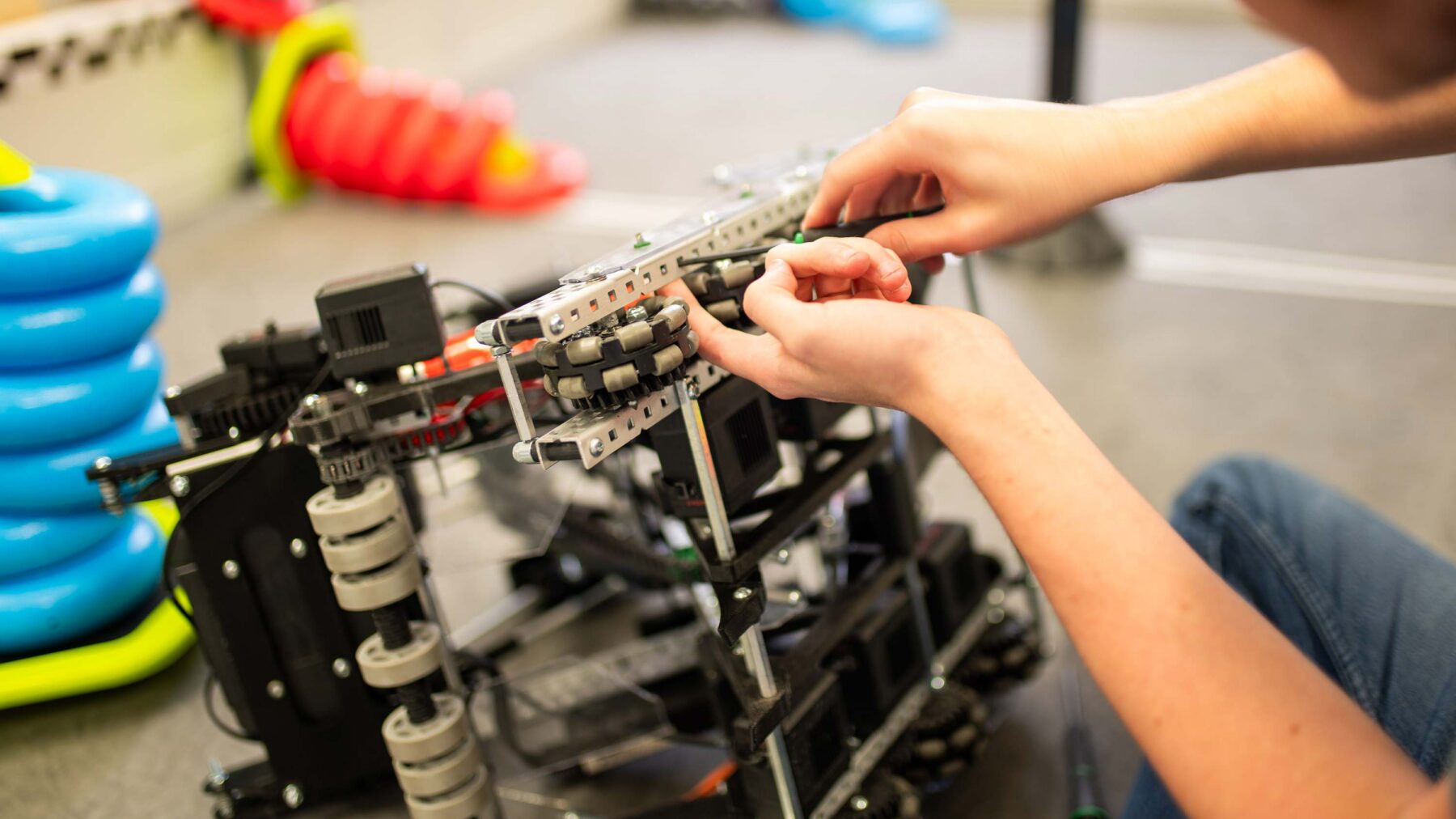
Competitions simulate real-world engineering challenges, where time constraints, resource limitations and unexpected problems require quick thinking and adaptability. For example, competitions have previously tasked teams with stacking rings on stakes to accrue points, while trying to prevent their opponent from doing the same. At the end of each game, the team with the most points is named winner.
For many students, robotics becomes a bridge between theory and real-world application.
Open to All Majors
While robotics is closely tied to STEM disciplines, participation is not limited to engineering or computer science students.
Moler emphasized that students from any academic background can contribute to the team and benefit from the experience.
“You don't have to just be in STEM; you can be in business or nursing or ag,” he said.
The university also offers a robotics club as an entry point for students with little or no prior experience, creating opportunities for broader involvement across campus.
Looking Ahead
As Lion Pride Robotics prepares for the VEX Robotics World Championship, the team is focused on refining its designs and building on its success.
For Wood, the team's confidence is rooted in preparation and continuous improvement.
“We will win the world championship through practice and iterative refinement,” Wood said. “I have great confidence in my teammates, and I will do everything I can to support our efforts.”
That confidence reflects a program that not only competes at a high level but also develops the next generation of innovators.
Through teamwork, hands-on learning and a drive to improve, the East Texas A&M robotics team is proving that success in competition begins with collaboration—and extends far beyond it.