



Community College Students Tackle Real-World Challenges Through Summer Research at East Texas A&M
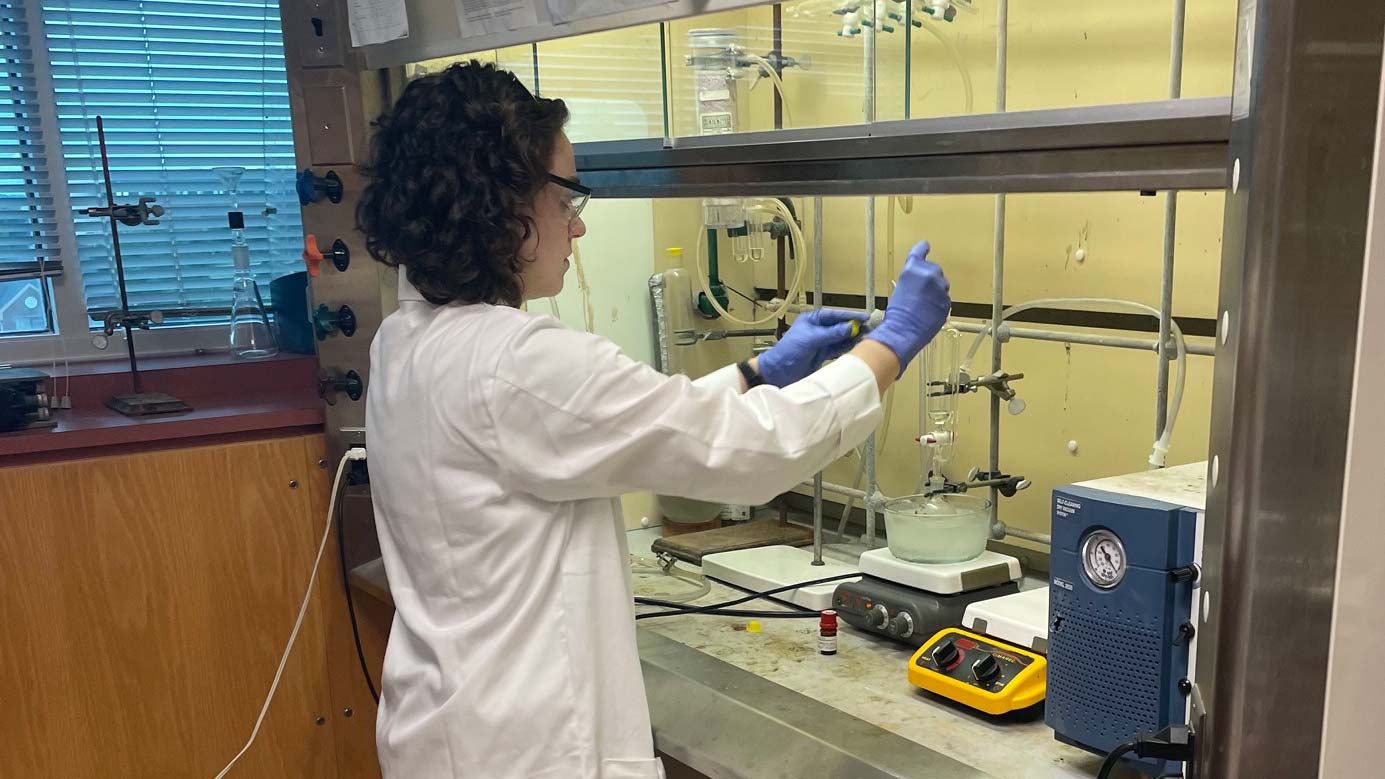
From developing sensors that detect “forever chemicals” to exploring new ways to reduce greenhouse gases, nine community college students have spent their summer tackling real-world scientific challenges at East Texas A&M University through the Research Experiences for Undergraduates program. Funded by the National Science Foundation, their work will culminate Aug. 6 during an annual symposium.
The 10-week residential program, hosted by the Department of Chemistry and led by Associate Professor Stephen Starnes, began on June 1 and pairs community college students with East Texas A&M faculty mentors for hands-on research in chemistry and biochemistry. The purpose of the program is to provide community college students with experience and faculty mentorship to prepare them for bachelor’s degrees, graduate study and STEM careers. This year’s participants represent Tyler Junior College, Paris Junior College, Grayson College and Tarrant County College.
During the symposium, students will gather in the Science Building to deliver oral presentations and present research posters to family members, faculty, fellow students and instructors from their home institutions.
Throughout the summer, students investigated a wide range of research topics, including using algae to remove heavy metal contaminants from the environment, developing sensors for perfluoroalkyl substances (PFAS), creating materials for organic solar cells, designing metal-binding tags for protein purification, developing catalysts to reduce greenhouse gas emissions from methane and optimizing chemical reactions used in drug discovery. In addition to laboratory research, participants received training in scientific writing, project management and professional presentations while visiting Eastman Chemical and UT Southwestern to learn about careers in chemistry and related industries.
“The REU program is always rewarding,” Starnes said. “We bring in students who have little to no prior research experience but a strong desire to learn and contribute to research. By the end of the program, they have developed research skills that confirm their interest in chemistry and prepare them to continue their studies toward careers in scientific research.”
The program’s impact extends well beyond a single summer. Former participant Matthew Jordan began his college career at Northeast Texas Community College before joining the REU program in 2014. He later earned a doctorate in chemical engineering and now serves as director of electrochemical technology at EnergyX, where he helps develop advanced technologies for domestic lithium production. Jordan regularly returns to East Texas A&M to speak with current students about careers in the chemical sciences.
Another former participant, Johnathan Bailey, completed the REU program before earning a bachelor’s degree in chemistry at East Texas A&M, followed by a doctoral degree from Texas A&M University. After serving as a senior scientist with biotechnology company 10x Genomics, he recently returned to Texas as a chemistry instructor at Northeast Lakeview College and continues to mentor aspiring scientists through presentations at East Texas A&M.
For prospective students interested in chemistry, engineering, and other STEM fields, the REU program demonstrates how hands-on research and faculty mentorship can open doors to graduate education, industry leadership, and careers solving some of today’s most pressing scientific challenges. To learn more and apply for next year's REU, students can visit the Research Experience for Undergraduates webpage.