



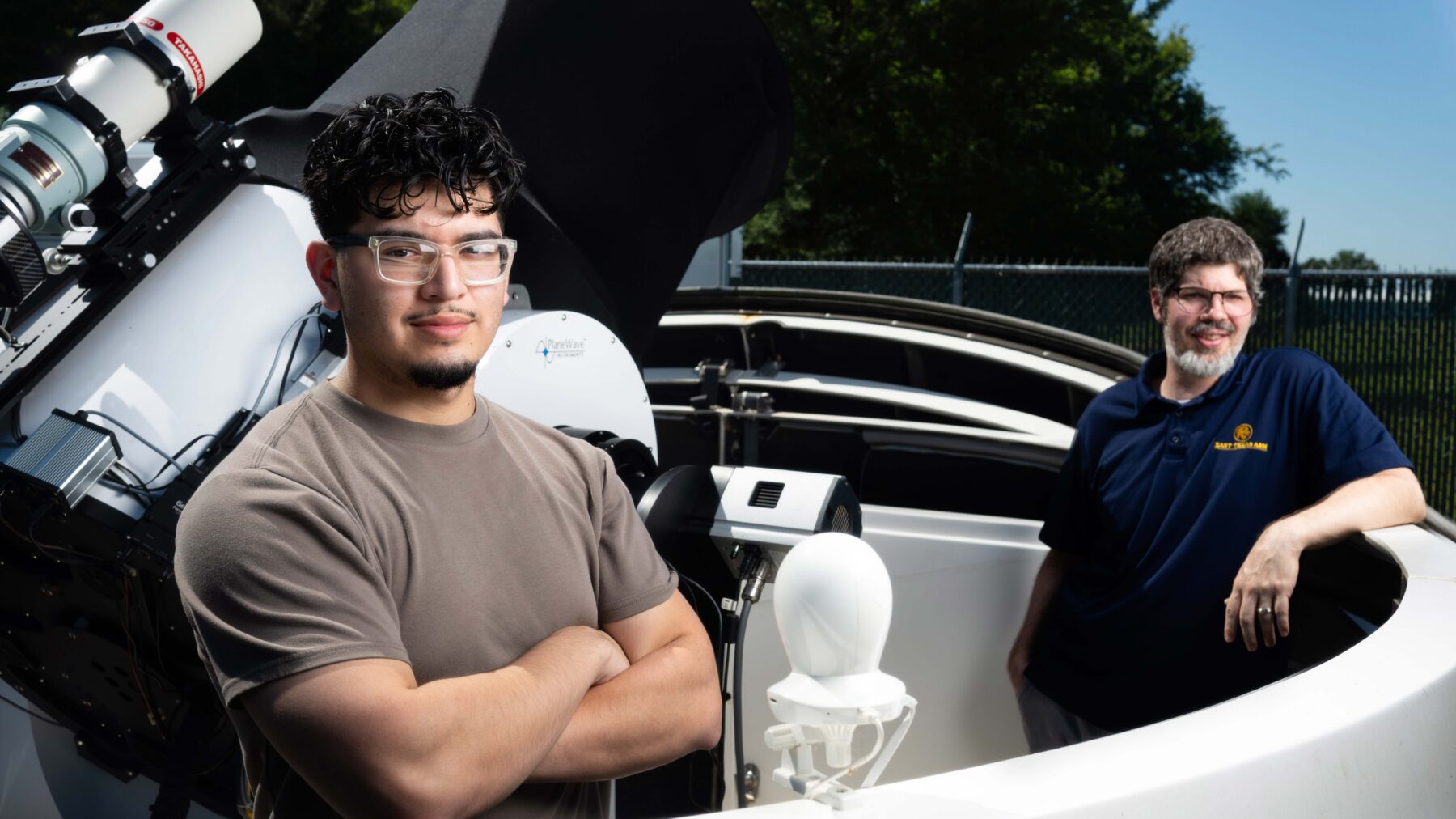
Astrophysics Undergrad Earns First-Author Publication in Renowned Astrophysical Journal
The Pittsburg native transformed a childhood fascination with the night sky into graduate-level research published in one of astronomy’s leading journals.
When Alan Briseño was 11 years old, growing up beneath the dark skies outside the small East Texas town of Pittsburg, he spent countless nights looking through a telescope his mother bought after months of persistent requests. Today, that childhood fascination with the cosmos has led to a milestone few undergraduate students achieve.
Briseño, an East Texas A&M University astrophysics student, is the first author of the research paper, “Tidal Evolution of Packed Moon Systems Around an Earth-Mass Planet,” published in The Astrophysical Journal, one of the world’s leading peer-reviewed journals in astronomy and astrophysics. As first author, Briseño led the research and wrote the paper.
For Briseño, the publication marks the culmination of more than a year of research while balancing a full course load, scholarships and other academic responsibilities.
“I was really happy seeing all my hard work—all my years of work—finally getting noticed,” Briseño said. “It’s a high-reputation journal, so it’s really exciting to see that, especially doing all this as a sophomore while taking classes.”
His excitement only grew after the paper completed peer review with relatively few requested revisions.
“I’ve heard stories where people immediately get rejected or have to go through a long revision process,” Briseño said. “When we got the comments back, and there were only a handful, that was really nice to see.”
Searching for Distant Moons
Working alongside his research advisor, Dr. Billy Quarles, assistant professor of physics and astronomy, Briseño investigated a question that could help astronomers better understand planetary systems beyond our own: How many moons can realistically orbit an Earth-sized planet over long periods of time?
The research builds on previous studies by incorporating the effects of tidal forces—the same type of gravitational interactions responsible for Earth’s ocean tides—into computer simulations of Earth-like planets and their moons. The team’s findings suggest these tidal interactions significantly reduce the number of stable moons such planets can support over billions of years, providing astronomers with more realistic expectations as future space telescopes search for moons orbiting planets outside our solar system.
Briseño said the research is particularly timely as the next generation of observatories prepares to study Earth-like planets in greater detail.
“Upcoming missions are going to target terrestrial planets in the habitable zone of their stars,” he said. “Our work helps provide an idea of what astronomers should be looking for when they’re searching for moons around those planets.”
As the first author, Briseño’s responsibilities extended well beyond contributing data. He modified and expanded the project’s computer code, incorporated new tidal models, created the figures and visualizations, wrote the initial manuscript and worked through revisions with Quarles before the paper was accepted.
Quarles said accomplishments like Briseño’s are uncommon for undergraduate students, particularly at such an early stage in their college careers.
“Alan is a rare student,” Quarles said. “He’s performing graduate-level research while taking the foundational courses in a physics degree.”
A Passion Born Under East Texas Skies
Briseño’s path to publication began long before he arrived on campus.
Growing up in rural East Texas, he regularly stepped outside to admire the stars and eventually convinced his mother to buy him his first telescope. As a teenager, he saved enough money to purchase a computerized telescope and later began sharing astronomy content on social media, where he built a following of thousands.
When he arrived at East Texas A&M, he learned Quarles had recently joined the Department of Physics & Astronomy. Although he had no experience, Briseño reached out to ask about research opportunities.
“I just sent him an email,” Briseño said. “We talked for about an hour or two, and he had an undergraduate research position open. He knew I had no prior knowledge of programming, but he was willing to teach me. I’m really grateful for that.”
Research Starts Early
The Department of Physics & Astronomy provides students with opportunities to work alongside faculty on research spanning astrophysics, astronomy, nuclear science and other areas of physics. Undergraduate students also gain hands-on experience using research facilities while preparing for careers in industry, government laboratories or graduate school.
“If you really put your mind to it and you’re passionate about it, you can do the same thing,” Briseño said. “When I came in my freshman year, I had no prior knowledge of programming. Dr. Quarles taught me everything I needed to know, and everything just stacked on top of each other.”
Looking ahead, Briseño plans to pursue graduate studies focused on exoplanets and exomoons before eventually becoming a professor himself.
“If you had told freshman me during my first semester that I’d have a paper published by my junior year,” he said, “I would not have believed you.”